




A former children’s librarian and an author share why picture books are still good for what ails us.
A former children’s librarian and an author share why picture books are still good for what ails us.
When I was young, I took solace in the experience of Chibi, a small, shy, mostly illiterate Japanese boy in Taro Yashima’s picture book Crow Boy. Chibi got teased at school and struggled to learn, but he never missed a day. A new teacher recognized Chibi’s gifts in art and imitating the crow calls that he heard in the mountains as he walked to and from school. In time the kids’ teasing turned to respect, and he was affectionately called “Crow Boy.” As a freckle-faced redhead at a Bay Area primary school, heckled daily for my ginger features, I remember drawing comfort from Crow Boy—I too wanted to be recognized for who I was.
In an age of cellphones, reels, and memes for ever-younger audiences, the power of illustrated children’s books to positively shape a child’s rapidly expanding world should not be forgotten. Whether it is to bond with parents and siblings, develop empathy, show the moral strength of choice, or reinforce healthy character traits, reading picture books with a child does good beyond building literacy.
Bound by Books
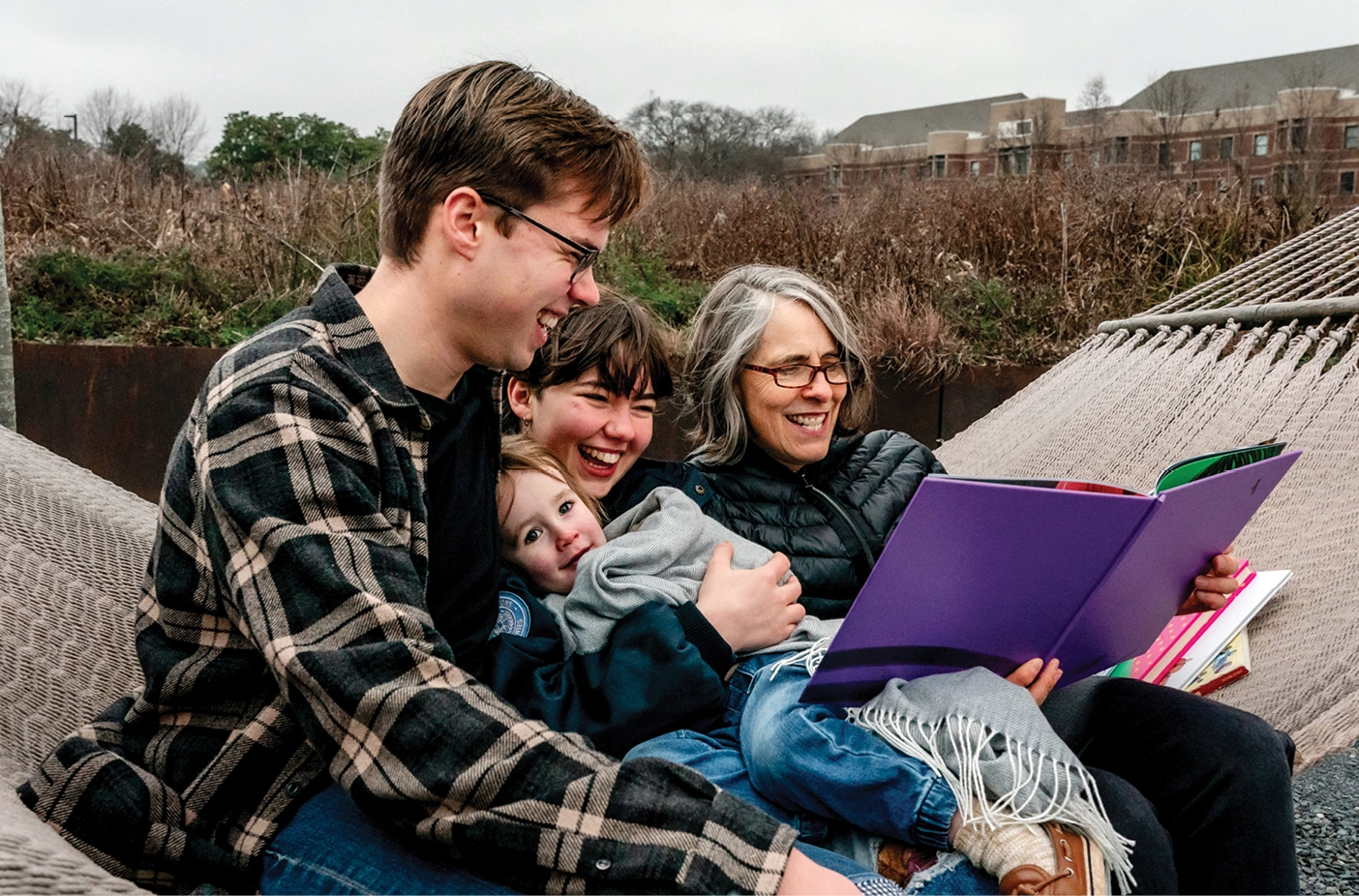
“As a child, I associated reading with comfort,” says Katie Treharne Lewis (BA ’00), BYU Studies senior editor and a former children’s librarian. “If kids are to learn how to love reading, they need to associate it with either a safe relationship or a safe environment.” Lewis grew up reading with her parents and her sister. As a parent Lewis did the same with her daughters. She says the emotional closeness of reading with a parent lets children learn life lessons and to navigate new or uncomfortable situations from a place of safety.

“You’re creating an experience as you read; you’re not a passive recipient,” says children’s book writer Annette Bay Pimentel (’85). Each book thus becomes a teaching opportunity.
Picture books “are not really intended for a child to read by themself but for a child to share with an adult,” says Pimentel, who studied English at BYU before finishing her degree at UC Berkeley. “I have happy memories of my mom reading to me, but I think picture books also connect kids to teachers and to other people. It’s their first entry into the wider world.”
Windows, Mirrors, and Glass Doors
Pimentel likes the metaphor used by Rudine Sims Bishop that children’s books should be windows, mirrors, and sliding glass doors. As windows, books let young readers glimpse the lives and experiences of others, which fosters empathy; mirroring books offer children reflections of themselves and their culture; sliding-glass-door books allow children to enter unfamiliar worlds, if only in their imagination.
A child’s innate curiosity, kindness, and sense of right and wrong lend themselves to empathy. “If the illustrations are done well, kids can put themselves right in the scene, and they get to experience this child’s or that animal’s point of view,” says Lewis. So it was for Lewis, who says books taught her to care for and protect the vulnerable, those “on the edges of society. . . . I got that from reading.”
Writing Their Own Story
Books teach children about the power of agency. Pimentel loves nonfiction stories for young readers because “there is a subtext that the way the world is right now doesn’t have to be the way that it stays.”
As a child she loved the Childhood of Famous Americans series, about real people who changed the world, and it has echoes in her own writing. For example, Pimentel’s book All the Way to the Top is about Jennifer Keelan-Chaffin who as a wheelchair-bound girl fought for Americans with disabilities. “I like the idea of agency, that even someone who seems to be powerless can take steps to shape the world in a slightly new way that matters.”
Building Characters
Admirable character traits like honesty, wisdom, tolerance, moral courage, and other virtues are easier for children to visualize and understand in an illustrated story. Lewis recalls the lesson Wende Devlin’s Cranberry Thanksgiving taught her about judging people based on appearances. In it a well-dressed baker is trying to steal Grandmother’s famous cranberry pie recipe, but Grandmother suspects the rough-hewn man her granddaughter brought to Thanksgiving dinner as the obvious thief when he is the one actually trying to help her.
Good books shared with children can frame the way they see the world and build their character in important ways. They may learn that life, though difficult, is a blessing. Or that little decisions have great consequences. Or how each person has gifts and talents to help them navigate life’s challenges.
Pimentel remembers, when moving as a child from Washington state to Illinois, taking the Golden book Little Lost Kitten with her. It was a gift from the ward’s Primary secretary to her, “a very bad nursery child” who needed special jobs to keep her in the nursery. “That book in particular,” Pimentel says, “and many books still in my life have to do with connections to other people and the experience of reading them together. I love that book because it reminds me of that relationship with a grownup.”