Promise and Peril at 250

At a time of both celebration and concern, the United States can take guidance from its illustrious past and the wisdom of a modern prophet.
By Thomas B. Griffith (BA ’78) in the Summer 2026 issue
Even though I was born on July 5, my family always celebrated my birthday on the Fourth. At the hour of my birth on a US military base in Japan, it was July 4 across the international date line in the United States. That was good enough for my patriotic parents. Which means I’ve never been entirely certain how much of my love of Independence Day is patriotic fervor and how much is narcissism. I have always loved Independence Day. Whether I was on the National Mall in Washington, DC, listening to the National Symphony Orchestra play patriotic songs while the monuments to Washington, Lincoln, Jefferson, and King were illuminated by fireworks or sitting in LaVell Edwards Stadium in Provo for the Stadium of Fire’s full-throated celebration of our nation’s independence—I have reveled in the day and cherished what it represents.
But this year my celebration will be different. We mark 250 years since the signing of the Declaration of Independence, what Jefferson scholars have called the document containing “the greatest sentence ever written”:1 “We hold these truths to be self-evident, that all men are created equal, that they are endowed by their Creator with certain unalienable Rights, that among these are Life, Liberty and the pursuit of Happiness.”2 But we celebrate under ominous clouds. Contempt courses through the veins of our body politic. We don’t just disagree with our fellow citizens anymore. We think they are evil and immoral. Can we create “a more perfect union”3 in the civic climate President Dallin H. Oaks (BS ’54) has described as “toxic?”4 This question will accompany me through the parades, the fireworks, and the J-Dawgs with special sauce and onions.
I’ll read the Declaration of Independence itself—that takes only a few minutes. I’ll read the Constitution. That takes a little longer. But then—realizing how remarkable it is that one of the nation’s most respected constitutional scholars has been called to preside over The Church of Jesus Christ of Latter-day Saints at this critical moment—I’ll spend time studying five extraordinary recent contributions from President Oaks: his April 2021 general conference address;5 his November 2021 Joseph Smith Lecture at the University of Virginia;6 his December 2021 address at Rome’s Sapienza University;7 a 2023 interview in Judicature,8 the leading publication for American judges, in which he elaborated on the Constitution’s inspired principles and the imperative of principled accommodation; and his Easter Sunday address at the last general conference. Together they form a coherent and urgent message for our moment.
A Crisis of Contempt
I agree with those who say we are in a constitutional crisis, the most serious since the Civil War. But the crisis is not primarily about executive overreach, congressional dysfunction, or threats to religious liberty, though each of these deserves careful attention and discussion. The greater crisis is about toxic political polarization, a cancer corroding our civic life.
Our public discourse is poisoned by contempt. Social science research shows that America is more polarized today than at any time since the Civil War.9 A remarkable Pew survey found that the United States is the only nation in the world where a majority of citizens believe that most of their fellow citizens are immoral and corrupt.10 Social psychologist Jonathan Haidt has issued a stark warning: “There is a very good chance that we will have a catastrophic failure of our democracy because we just don’t know what a democracy looks like when you drain all trust out of the system.”11
The problem isn’t that we disagree about important matters. We’ve always done that. It’s that we do so today with contempt for those who see things differently. The late Michael Gerson rightly explained that the Constitution “is designed for vigorous disagreement. It is not designed for irreconcilable contempt. Such contempt loosens the ties of citizenship and undermines the idea of patriotism.”12
Latter-day Saints have long felt a sense of stewardship regarding the Constitution, a duty to “support and defend” a document we hold to be divinely inspired (see D&C 101:77). There may be no better time than now to think carefully about what that stewardship requires. And there is no better teacher at this moment than President Oaks.
Moderate and Unify
I have been a student of the Constitution for all my adult life. I carry a pocket copy everywhere. I’ve read the best scholarship and built a legal career—as chief counsel to the US Senate, a federal appellate judge, and now a law lecturer—on its foundations. I always believed the Constitution’s primary purpose was to protect rights and limit government power. That is critically important.
But I have come to understand, in large part because of President Oaks’s teachings, that there is another purpose of the Constitution every bit as important. The Constitution was also designed to teach us how to live with people we disagree with. This is a lesson we desperately need today.
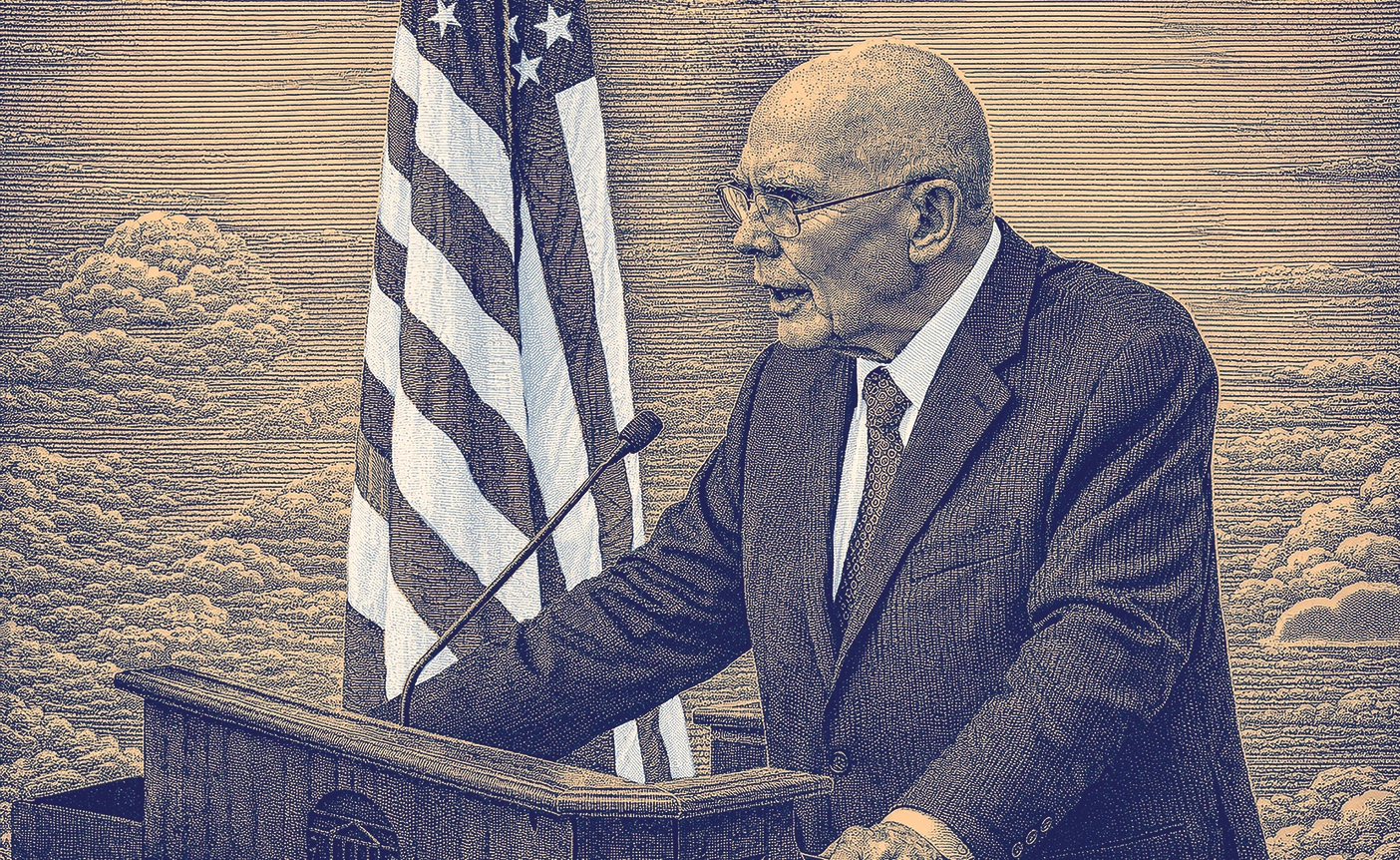
In a landmark general conference address in April 2021, “Defending Our Divinely Inspired Constitution,” President Oaks set forth with force and clarity the role Latter-day Saints are to play at this moment of bitter division.13 If you are wondering what you can do to “uphold and defend the United States Constitution,” President Oaks has the answer. Our charge is to “exercise our influence civilly and peacefully” and “on contested issues, we should seek to moderate and unify.”
Months later President Oaks gave the fullest articulation of this charge in a remarkable address at the University of Virginia. Speaking, he announced, with the united voice of the First Presidency and the Quorum of the Twelve—and describing it as the most difficult talk he had ever prepared—President Oaks explained how witnessing the nation’s culture wars had changed his own perspective. He spoke of a deepening empathy he experiences for those who feel that others invoke constitutional rights to deny or diminish their own. “We need to work for a better way—a way to resolve differences without compromising core values.”14
What does that look like in practice? President Oaks pointed to the Utah Compromise of 2015 as a model. In a historic piece of legislation, enacted with the full support and active engagement of the Church, Utah’s legislature crafted significant protections both for religious freedom and against discrimination based on sexual orientation.15 Leaders of the LGBT community hailed the statute a landmark.16 What made it possible was not legal cleverness alone. The compromise was worked out not only around conference room tables or lawyers’ offices but around dining room tables, among people who developed real relationships despite their differing views. As friendship formed, ideas emerged about how each side could accommodate the needs of the other while maintaining its core values.17
Elder Alexander Dushku, then representing the Church’s interests in the negotiations and now a general authority Seventy serving as the Church’s general counsel, described the process as transformative: “The effort taught us to be more practical and less ideological. It taught us to listen carefully and understand opposing views. It taught us to respect and trust each other in new ways. . . . It taught us . . . that we actually agree on most truths, not all but most.”18 Troy Williams, then head of Equality Utah, echoed this: “Neither side compromised our values, but rather, we discovered new ways forward that respected each other and forged areas of common ground.”19
According to President Oaks, this is what it looks like to seek to moderate and unify on contested issues. But President Oaks insists on something more demanding still. We must not allow our fears about losing our own freedoms make us “insensitive to others’ claims for theirs.” The freedom and protection we seek must be “not for ourselves alone.”20 President Oaks elaborated on this in the Judicature interview. What we should seek is not total victory but what he called “principled accommodation”—a mutual respect that looks not to what is surrendered but to what is gained.21 In his Rome address, the apostle insisted, “We should not expect or seek total dominance for our own positions, but in the exercise of mutual respect should seek fairness for all.”22 The journalist Jonathan Rauch—a self-described liberal, atheist, Jewish homosexual—observed that what President Oaks has been teaching is “conspicuously countercultural in the conservative religious world” and may offer the best path, perhaps the only path, out of our current constitutional peril.23 Countercultural, yes. But following Jesus’s charge to be peacemakers has always been countercultural.
In Rome President Oaks issued this imperative: “With the love and mutual respect enjoined by divine commandments, we need to find ways to learn from one another and to reinforce the common insights that hold us together in a stable, pluralist society.”24
Bonds of Affection
President Oaks’s approach, while it cuts against the grain of much political discourse today, stands in a long tradition in American public life. Matthew S. Holland (BA ’91), a scholar-turned-general-authority calls this tradition “civic charity” and argues that it was central to the creation of the United States and is indispensable to the functioning of the Constitution’s structural architecture: federalism, separated powers, enumerated rights.25
The framers of the Constitution gave that spirit its institutional form. The Constitutional Convention of 1787 came dangerously close to collapse. By early July George Washington and Benjamin Franklin were, as one early historian noted of Washington, “much dejected at . . . the deplorable state of things in the convention.” Tempers flared, delegates threatened to leave, and a “dissolution of the Convention was hourly to be apprehended.”26 And yet by mid-September, those same delegates had produced the document that gave form to the United States of America.
George Washington explained how this happened in his letter transmitting the Constitution to Congress. In a statement that was affixed to many of the earliest copies of the Constitution as a sort of preface, Washington explained that the Constitution was “the Result of a Spirit of Amity and of that mutual Deference & Concession which the Peculiarity of our political Situation rendered indispensable.”27 Amity. Mutual deference. Concession. Three terms that contain a whole civic philosophy.
What generated that spirit? At least in part, it was the practical fact of proximity. As legal scholar Derek Webb has shown, the convention’s rules assumed something radical: that if you brought people together and had them truly listen to one another, they might change their minds.28 Delegates dined together, socialized, even partied. Benjamin Franklin opened his cellar of port to ease tensions. Over time, men from South Carolina and Massachusetts formed what George Mason called “a proper correspondence of sentiments.”29 Former strangers became friends who were willing to negotiate in good faith and make mutual accommodations for the sake of union. They did so because failure was unthinkable. They knew they were united in a civic project, and it depended on them to work it out, to—in the words of Benjamin Franklin—“keep” the republic.30
I fear we are in a similar moment. And the lesson of 1787 is not only what the framers wrote—the structure of separated powers, the guarantees of rights—but how they wrote it: with a spirit of amity that made compromise possible.
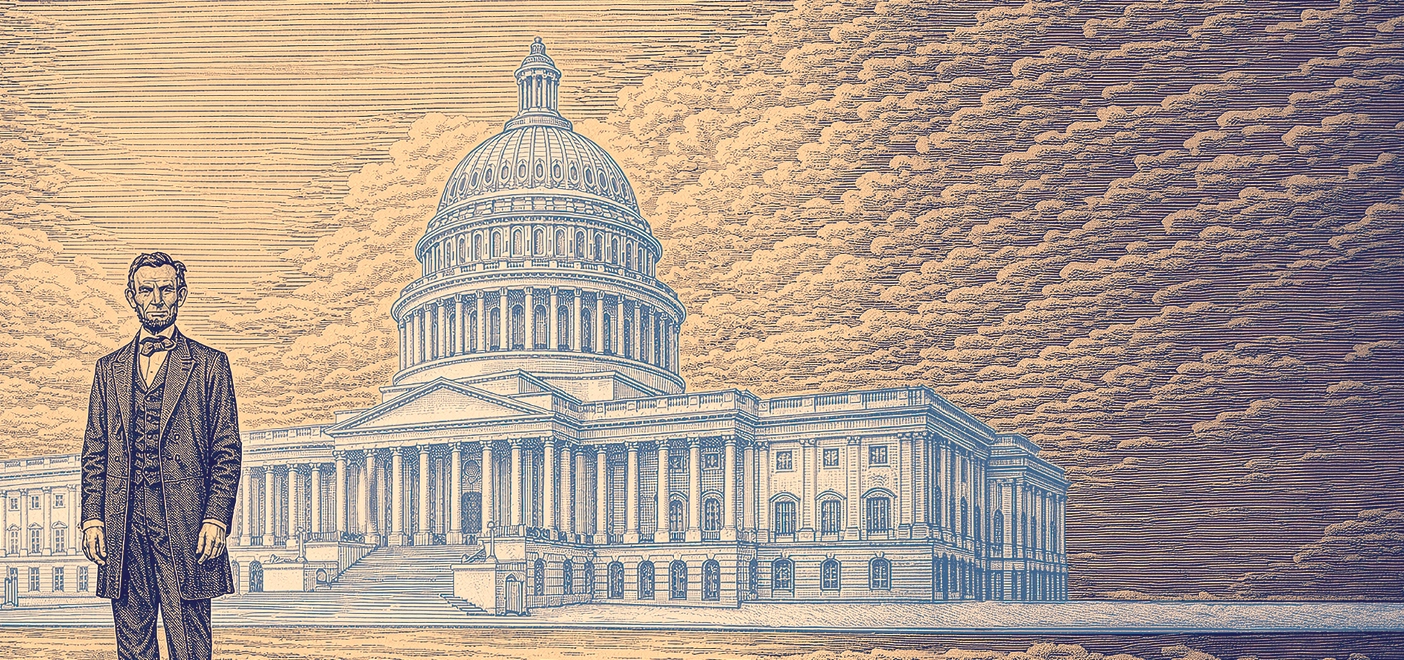
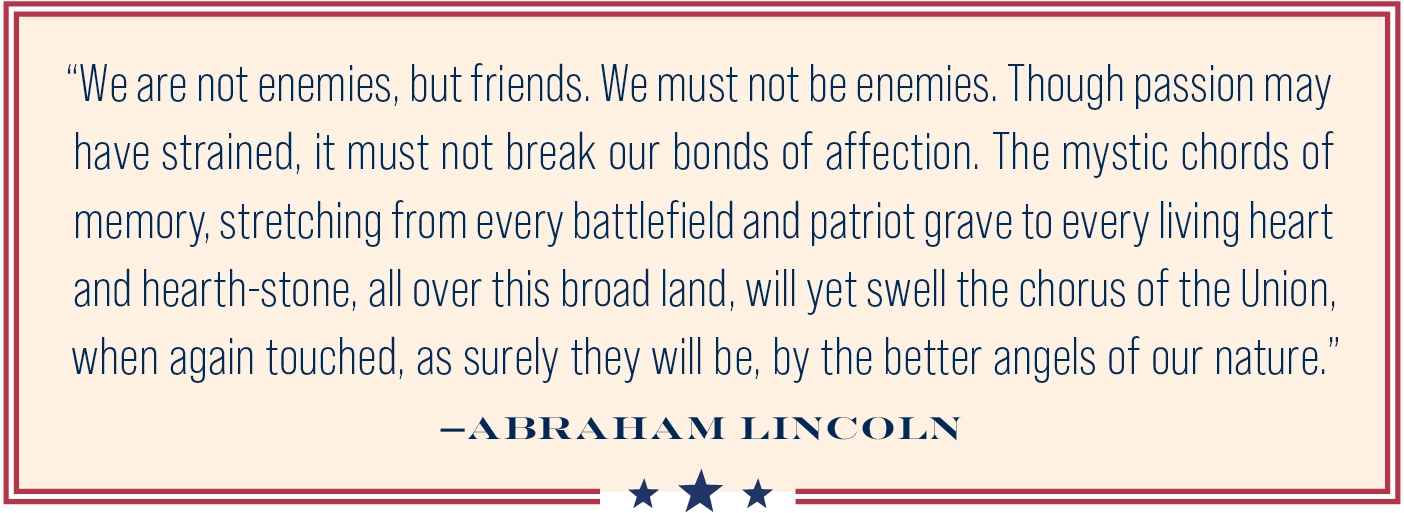
Some 74 years later Abraham Lincoln gave the most eloquent expression to civic charity—and, it turned out, the most tragic. Standing at the steps of the Capitol as seven states had already seceded from the Union, Lincoln pled:
We are not enemies, but friends. We must not be enemies. Though passion may have strained, it must not break our bonds of affection. The mystic chords of memory, stretching from every battlefield and patriot grave to every living heart and hearth-stone, all over this broad land, will yet swell the chorus of the Union, when again touched, as surely they will be, by the better angels of our nature.31
Those bonds did not hold. Civil war came, and its consequences are with us still. But Lincoln’s words endure as both summons and warning: bonds of affection are not self-sustaining. They must be chosen, tended, and renewed, especially when passion has strained them.
Yuval Levin argues that the Constitution itself was designed with this in mind. It isn’t just a charter of rights or a blueprint for government. It is a framework for national unity amid difference.32 The Constitution is designed to bring competing interests into structured deliberation. Its architecture of separated powers ensures that no one branch of government makes decisions before differing viewpoints can be considered. In the words of Justice Neil Gorsuch, this is where “deliberation tempers impulse, and compromise hammers disagreements into workable solutions.”33 The Constitution forces us to work together in relationships of mutual dependence.
As Levin puts it: the Constitution “compels Americans with different views and priorities to deal with one another—to compete, negotiate, and build coalitions in ways that drag us into common action even (indeed, especially) when we disagree.”34
Such a system demands a new kind of citizen—one who listens to opponents, seeks common ground, and understands that compromise is not betrayal but constitutional duty.
A More Perfect Union
In his first general conference address as president of the Church, President Oaks tied together all these themes in a moving plea that we be peacemakers, as the Lord commands, not only in our families and wards, but in the life of our nation. Noting that “many current writers characterize the time in which we live as toxic, a time of contempt or hostility toward adversaries,” President Oaks explained that Jesus’s command to “love [our] enemies” (Matt. 5:44) is best understood as a command to “love our adversaries,” which includes those who “actively oppose” our political views. “Peacemakers!” President Oaks exclaimed. “How it would change the world if followers of Christ would forgo harsh and hurtful words in all their communications.”
President Oaks noted that followers of Jesus embrace diversity because, quoting the words of President Howard W. Hunter, “the pure love of Christ . . . encourages diverse people to live together in Christian love regardless [of their differences].” Even when those differences are profound, President Oaks added, “as followers of Christ, we should seek to live peaceably and lovingly with other children of God who do not share our values.” This approach to living and working with those with whom we disagree is not only a spiritual imperative, it is a constitutional necessity. “In a democratic government,” President Oaks emphasized, “we should seek fairness for all.”
According to President Oaks, being a peacemaker involves more than a change of heart. It requires action, and he gave us specifics about what we are to do and what we are not to do. Being a peacemaker requires that we speak differently from what fills social media feeds, cable TV, and talk radio. It also demands that we “seek to reduce human suffering” and calls upon us to “promote understanding among different peoples.” It requires not only that we forgo contention, but that we use “the language and methods of peacemakers.”35
There is an insight in President Oaks’s talk that I missed the first time I heard it: He taught us that we must love even our political adversaries whose views we think are badly mistaken and consider ourselves “children of God who belong to each other.”36 There may be no more fundamental Restoration insight than that. President Oaks observed, “Our Savior, Jesus Christ, taught us how to relate to one another.”37 And that should begin with the understanding that we belong to each other.
So how best to celebrate America’s 250th? Not, I think, by retreating from the gravity of the moment. The storm clouds are real. But neither should we succumb to despair. The tradition of civic charity is as American as the Declaration itself. The spirit of amity saved the Constitutional Convention. It has surfaced at critical junctures throughout our history: in Jefferson’s conciliation after a bitterly contested election, in Lincoln’s call for “malice toward none,”38 in the civil rights movement’s redemptive moral vision, in the Utah Compromise of 2015.
That tradition is available to us now. President Oaks is reminding us of it, not just as a matter of civic pragmatism but as a matter of Christian discipleship.39 The Lord commands us to be peacemakers. The Constitution calls us to be citizens who can govern themselves across deep differences. Those are not competing demands. They are, at their best, the same demand.
As I watch the fireworks this July—whether from the National Mall or from Provo, whether the pyrotechnics arc over the Potomac or illuminate the mountains of Utah—I’ll be celebrating not just what was created 250 years ago but what we are called to keep creating: “A more perfect union.”40 Together. With amity and mutual deference. By healing, as Lincoln asked, our bonds of affection.
And I’ll be thinking about what New York Times columnist David French recently urged on all of us: “to turn to a friend, a neighbor and even an ideological opponent and sincerely ask one of the most important questions [we] can ask—what do you think?”41
Asking that question, genuinely posed and genuinely received, may be the most patriotic thing we can do during this summer of celebration.

Judge Thomas B. Griffith (ret.) is a fellow at the BYU Wheatley Institute and a lecturer on law at Harvard who formerly served as a judge of the US Court of Appeals for the DC Circuit, general counsel of BYU, and the chief legal officer of the US Senate.
NOTES
- See Walter Isaacson, The Greatest Sentence Ever Written (New York: Simon and Schuster, 2025).
- Thomas Jefferson et al., The Declaration of Independence, adopted July 4, 1776, paragraph 2.
- The Constitution of the United States, preamble.
- Dallin H. Oaks, “Alive in Christ,” Liahona, May 2026.
- Dallin H. Oaks, “Defending Our Divinely Inspired Constitution,” Liahona, May 2021.
- Dallin H. Oaks, “Going Forward with Religious Freedom and Nondiscrimination,” 2021 Joseph Smith Lecture, University of Virginia, Nov. 12, 2021.
- Dallin H. Oaks, address at Sapienza University, Rome, Italy, Dec. 14, 2021, newsroom.churchofjesuschrist.org/article/president-oaks-rome-religious-freedom-summary.
- David F. Levi and Dallin H. Oaks, “Faith in Law,” Judicature 107, no. 1 (2023), judicature.duke.edu/wp-content/uploads/sites/3/2023/06/OAKS-Vol-107-No-1.pdf.
- Arthur Brooks, “Our Culture of Contempt,” New York Times, March 2, 2019.
- Jonathan Evans et al., “In 25-Country Survey, Americans Especially Likely to View Fellow Citizens as Morally Bad,” Pew Research Center, March 5, 2026, pewresearch.org/religion/2026/03/05/in-25-country-survey-americans-especially-likely-to-view-fellow-citizens-as-morally-bad.
- As quoted in Paul Kelly, “‘Very good chance’ democracy is doomed in America, says Haidt,” The Australian, July 20, 2019, theaustralian.com.au/nation/politics/very-good-chance-democracy-is-doomed-in-america-says-haidt/news-story/0106ec1c458a0b5e3844545514a55b5a.
- Michael Gerson, “A Primer on Political Reality,” Washington Post, Feb. 19, 2010, washingtonpost.com/archive/opinions/2010/02/19/a-primer-on-political-reality/8e95f6cb-12f4-4c45-9214-d3bbdda882d0.
- Oaks, “Defending.”
- Oaks, “Going Forward.”
- Utah S.B. 296, Antidiscrimination and Religious Freedom Amendments, 2015 General Session (enacted March 12, 2015).
- See, for instance, comments cited in Matt Canham, “Read What Key Figures Say the ‘Utah Way’ Is,” Salt Lake Tribune, July 25, 2021, sltrib.com/news/politics/2021/07/25/read-what-key-figures-say.
- See Sarah Jane Weaver, “What 1 General Authority Seventy Learned After California’s Prop. 8 About Peacemaking,” Church News, July 12, 2024, thechurchnews.com/living-faith/2024/07/12/elder-alexander-dushku-2024-notre-dame-religious-liberty-summit-polarization-peacemaking-friendship-california-prop-8.
- Alexander Dushku, as quoted in ibid.
- Troy Williams, as quoted in Canham.
- Oaks, “Going Forward.”
- Levi and Oaks.
- Oaks, address at Sapienza University.
- Jonathan Rauch, “Latter-day Saints Can Save America,” Wayfare, July 1, 2025, wayfaremagazine.org/p/how-latter-day-saints-can-save-america.
- Oaks, address at Sapienza University.
- See Matthew S. Holland, Bonds of Affection: Civic Charity and the Making of America––Winthrop, Jefferson, and Lincoln (Washington: Georgetown University Press, 2007).
- Jared Sparks to James Madison, March 30, 1831, Founders Online, National Archives, founders.archives.gov/documents/Madison/99-02-02-2315.
- George Washington to the President of Congress, Sept. 17, 1787, Founders Online, National Archives, founders.archives.gov/documents/Washington/04-05-02-0306.
- Derek A. Webb, “The Original Meaning of Civility: Democratic Deliberation at the Philadelphia Constitutional Convention,” South Carolina Law Review 64, no. 1 (2012).
- George Mason to George Mason, Jr., May 20, 1787, in The Records of the Federal Convention of 1787, vol. 3, ed. Max Farrand (New Haven: Yale University Press, 1911).
- James McHenry, “Notes of the Federal Convention of 1787,” in The Records of the Federal Convention of 1787, vol. 3, ed. Max Farrand (New Haven: Yale University Press, 1911).
- Abraham Lincoln, “First Inaugural Address,” March 4, 1861.
- Yuval Levin, American Covenant: How the Constitution Unified Our Nation—and Could Again (New York: Basic Books, 2023).
- Neil Gorsuch, concurring, V.O.S.A. v. Trump, No. 24-1287, slip op. at 46 (US 2026), supremecourt.gov/opinions/25pdf/24-1287_4gcj.pdf.
- Levin, p. 3.
- Oaks, “Alive in Christ”; emphasis in the original.
- Ibid., emphasis added.
- Ibid.
- Abraham Lincoln, “Second Inaugural Address,” March 4, 1865.
- See Oaks, “Going Forward.”
- The Constitution of the United States, preamble.
- David French, “The Most Important Question Is ‘What if I’m Wrong?’” New York Times, Jan. 25, 2026, nytimes.com/2026/01/25/opinion/college-thinking-illiberalism.html.
Feedback: Send comments on this article to magazine.byu.edu.