




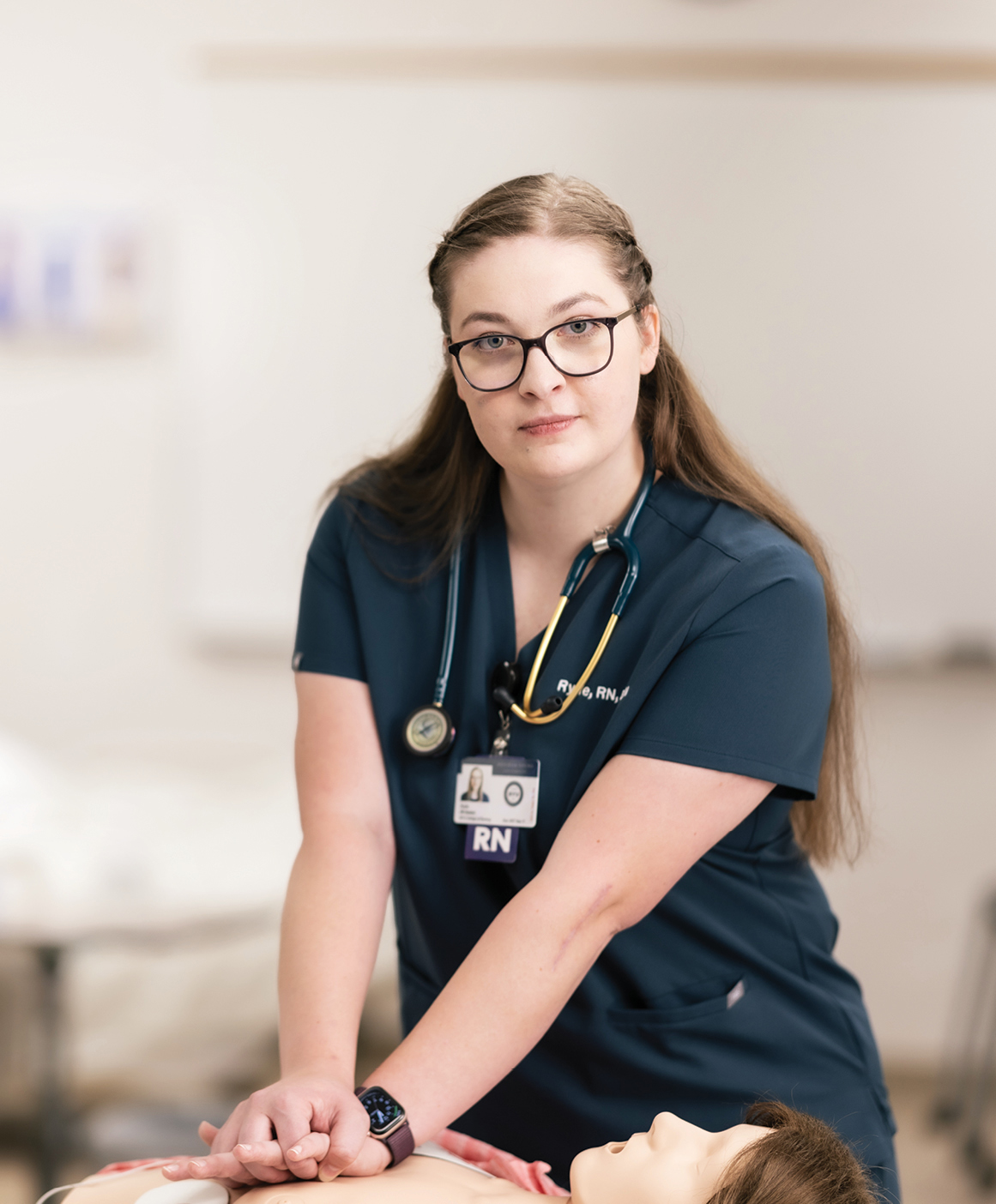
Photo by Bradley Slade.
The CPR training video started with a disclaimer: all victims shown would be male. Surprised, BYU nursing student Rylie B. Rasmussen (BS ’25) began watching other CPR training videos with a critical eye—and found that each one focused only on male victims. To Rasmussen, this raised a critical question: “If women aren’t being represented in CPR training, how does that affect female victims in real emergencies?”
Rasmussen dug into the data and learned that due to gender bias, social discomfort with female anatomy, and incomplete training, female cardiac arrest victims are less likely to receive CPR, urgent transport, advanced post-arrest treatment, and other life-saving measures. She gathered her findings into a research paper, describing the gender disparities that appear in each stage of the American Heart Association’s chain of survival. “The chain of survival only works if every link is strong for every patient,” Rasmussen says.
Rasmussen is gaining traction in the healthcare community as she advocates for greater female representation in CPR training. She presented her research to healthcare professionals at the Rural Health Association of Utah Conference and the BYU Nursing Research and Professionalism Symposium in 2025, and her paper will be published in the Journal of Advanced Nursing. Because of her research, the BYU nursing program purchased two female-bodied CPR manikins to use in future training.
“What’s incredible about Rylie is that she puts her whole heart into whatever she’s working on,” says Rasmussen’s mentor, nursing professor Adrianna L. Watson. “She’s trailblazing where it’s most needed, and I’m excited to see what she does next.”
Rasmussen plans to pursue a PhD, continue her research, and keep raising awareness of gender disparities in healthcare as she works as a nurse. “Small moments of curiosity,” she says, “can become opportunities to serve.”