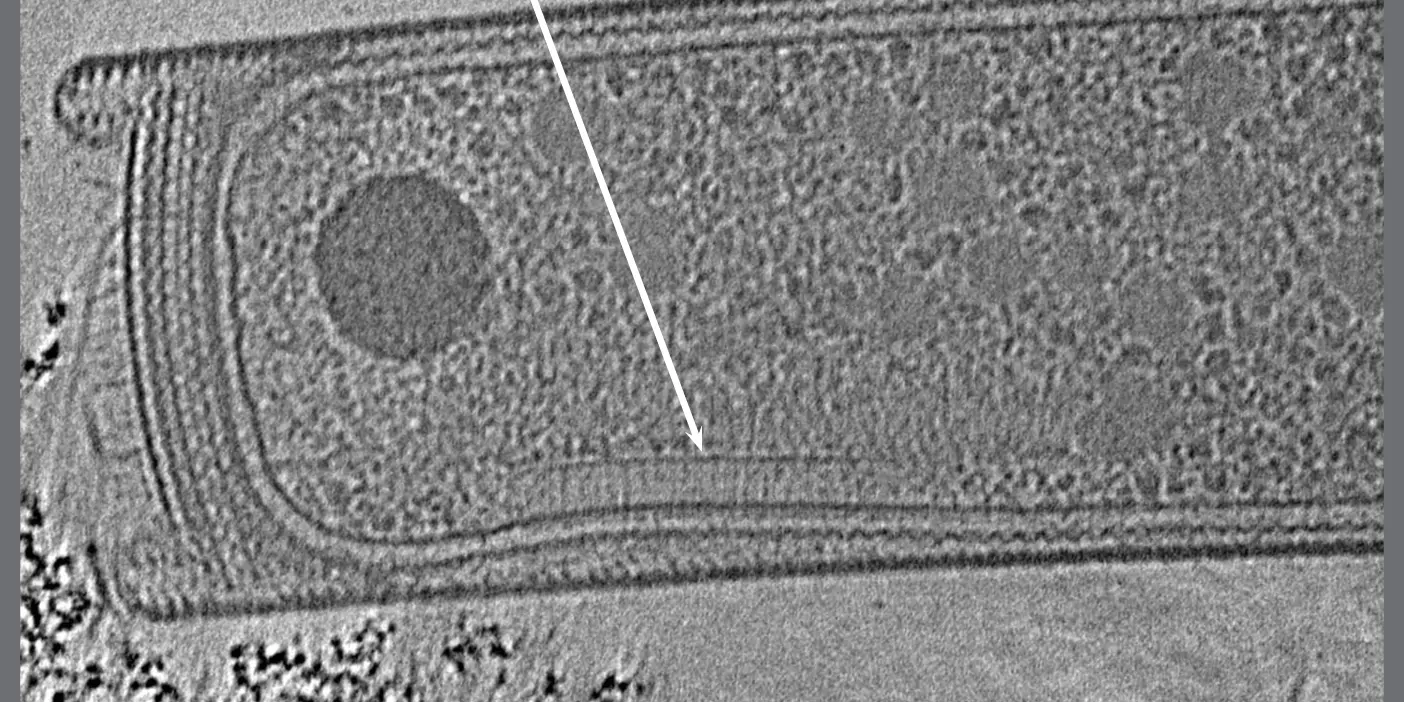





Scientists know how persisters—antibiotic resistant bacteria—function. They “go incognito,” explains post doc Chitral Chatterjee, or switch off all cell processes to hide from antibiotics. But scientists don’t know exactly what these tiny bacteria look like.
BYU’s new transmission electron microscope (TEM) will offer researchers in professor Grant J. Jensen’s (BS ’94) lab a glimpse at “persisters in their most native state,” Chatterjee says, something not possible through other microscopic techniques. The images will help better combat diseases like cholera.
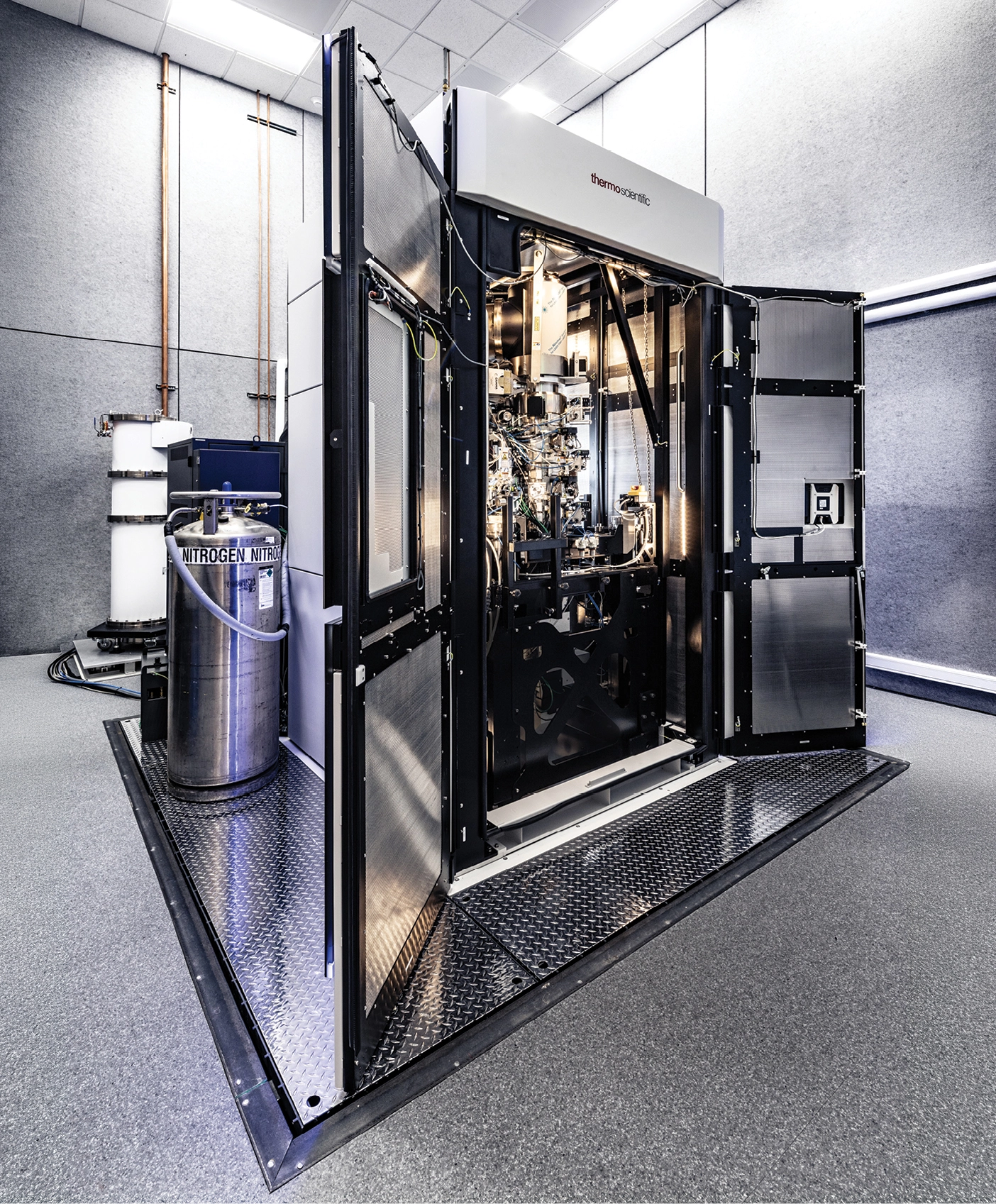
Located in the newly expanded Carl F. Eyring Science Center, the instrument accelerates electrons to illuminate tiny samples of cells. Because even the smallest vibration could interfere with the microscope’s precision, the TEM is encased in a room insulated by aluminum and steel; researchers operate it outside a closed door. By capturing images at different angles and creating a 3D model, researchers can visualize individual proteins and even the double helix of DNA.
BYU’s TEM will soon be joined by a second, more powerful microscope that can identify individual atoms. These instruments will expand campus research opportunities, teach marketable skills to student researchers, and become a resource for BYU’s future school of medicine.
“These tools are used for cancer research and drug development,” says Felipe Rivera (MS ’10, PhD ’12), director of the microscopy facility. “The medical community is going to benefit.” Undergraduates, he adds, are encouraged to use the microscopes for their own research, a learning opportunity “that sets BYU apart from every other place that has this type of instrumentation.”
300,000: The accelerating voltage used by the microscope, with electrons reaching speeds of about 80 percent of the speed of light. The average electric outlet is about 120 volts.
150 nanometers: The thickness of samples used in the TEM, about 0.0015 times the width of a single human hair. Biological samples are frozen to -195 degrees Celsius to prevent cells from moving.
Shake Proof: The TEM sits on a 4-foot thick concrete slab and vibration cancellation plates to isolate it from campus noises like construction and the tolling of the bell tower.