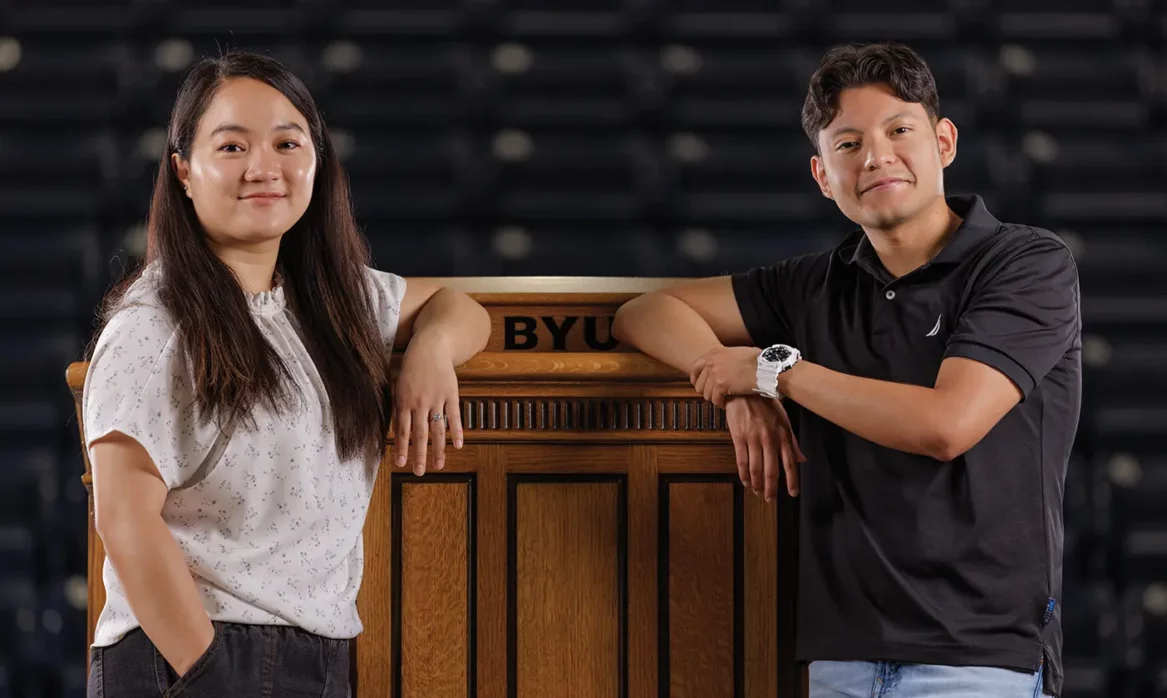





Timothy “Liam” W. Robinson (’26) is the winner of the 2025 Brimhall Essay Contest, which honored President Spencer W. Kimball as a BYU founder.

The fluorescent lights hummed overhead as I sat in my high school speech therapy session, a small gold sensor positioned carefully in my mouth. My therapist coached me through another round of r-sound exercises: “red,” “river,” “road,” each word emerging as an approximation of what it should be. I had been fighting this battle for years, my tongue stubbornly refusing to cooperate with the most common consonant in English. After months of practice with the sensor, my progress remained frustratingly elusive. I was left wondering if I would spend my entire life dancing around words that began with the letter r. My journey with a speech impediment taught me that sometimes God lights the way forward through the trials that appear to block our path.
From my earliest memories, the letter r had been my enemy. While other children learned to speak naturally, I developed an elaborate mental vocabulary of synonyms and substitutions. “Red” became “crimson,” “run” became “sprint,” and “really” became “truly.” My brain rewired itself around this obstacle, expanding my vocabulary in ways that seemed clever but were exhausting. My parents tried everything: traditional speech therapy, specialized devices, and even that revolutionary gold sensor. Yet improvement remained minimal.
By my senior year of high school, I had made peace with my impediment. I prayed often that the Lord would help me communicate effectively, understanding that language is fundamental to how we connect with and serve others. God heard those prayers.
When I received my mission call to Togo, West Africa, I felt a mixture of excitement and terror. Not only was I being called to serve in a foreign country, but I would be preaching the gospel entirely in French. I had struggled with French throughout high school. The prospect of mastering the language well enough to teach in it seemed daunting.
As I studied I realized something remarkable. The French r, with its distinctive guttural sound, felt completely natural to my tongue. For the first time in my life, I could pronounce every r-word without hesitation or embarrassment. The impediment that had defined my relationship with English simply vanished in French. I could speak freely, without the constant mental calculations that had characterized my communication for years. Undoing this mental block somehow improved my ability to pronounce the English r as well, and today I pronounce r’s the best I ever have in my life.
This transformation reminded me of President Spencer W. Kimball, whose own trials with speech became a testament to God’s ability to light the way forward through seemingly impossible circumstances. When throat cancer robbed President Kimball of his vocal cords in 1956, doctors told him he would never speak above a whisper again. For a man whose ministry depended on his voice, this diagnosis must have felt devastating. Yet President Kimball refused to accept defeat. When President David O. McKay encouraged him to regain his voice because he “still had a great mission to perform,” President Kimball embarked on the difficult process of retraining his speech using scar tissue and careful breath control.
God’s light often shines brightest through the cracks in our apparent weaknesses.
President Kimball’s determination exemplified his philosophy: “Give me this mountain to climb.” Rather than viewing his trials as obstacles, he saw them as opportunities for growth and faith. His various health challenges became steppingstones that strengthened his resilience and deepened his trust in divine purposes. He taught that “in the face of apparent tragedy we must put our trust in God, knowing that despite our limited view His purposes will not fail.”
My mission experience validated this principle completely. What had been my greatest weakness in English became my strength in French. I returned home fluent, worked in the BYU French Grammar Lab, interned in Paris, and now speak French nearly as well as my native language. The Lord had indeed lit the way forward, transforming years of struggle into a path of service and connection with others.
Both President Kimball’s journey and my own illustrate a fundamental truth: God’s light often shines brightest through the cracks in our apparent weaknesses. Our limitations need not define our lives. Instead, they can become the foundation of our greatest contributions.