




After sitting in storage for decades, a replica of Lorenzo Ghiberti's celebrated sculpture gets new life at the BYU Museum of Art.

While cleaning out a BYU–Hawaii art storage room more than a decade ago, service missionary Sharon R. Gray (BA ’68, EdD ’92) stumbled across a hidden treasure sitting in crates. “I pulled the bubble wrap back and saw these faces that I recognized,” she recalls. A former BYU art professor, in 1984 Gray had studied in Florence, Italy, and she immediately recognized what she had uncovered: a plaster replica of early Renaissance sculptor Lorenzo Ghiberti’s famed Florence Baptistery doors. “I was astonished,” she says.

The original gilded bronze panels have been celebrated as a crown of Renaissance art since the 15th century. Impressed by their magnificence, Michelangelo dubbed them the Gates of Paradise.
But what were they doing in Laie, Hawaii? “I became a detective,” says Gray, “trying to figure out the provenance of these pieces.” And what should be done with them now?
The panel replicas, she learned, had been cast after World War II and eventually acquired by BYU–Hawaii art faculty Jan G. Fisher (BA ’65). Transported to Laie, they had been sitting in storage for more than three decades without an adequate place to display them or the resources to restore them. Gray, determined to give the panels proper care and a permanent home, started making phone calls.

Thanks to a generous donation from William P. (BA ’71, MBA ’73) and Barbara Taylor Benac (BA ’91) and a collaborative effort between BYU–Hawaii and BYU’s Museum of Art, the plasters arrived in Provo in July 2016. A team of art curators, production specialists, and students would spend the next decade restoring the panels to their original grandeur. It wasn’t easy.
When the panels first arrived, the restoration team found figures with snapped-off limbs, a dog with a chipped nose, and panels that had broken completely in half. Formerly sharp edges had worn away; faces had lost detail. The final condition report detailing each of the flaws was more than 300 pages long.
“I had to learn a lot about plaster,” says John Q. Adams, the MOA’s manager of exhibit production and installation. “There’s more than just adding powder to water.” The team mended the plaster with painstaking detail, carefully researching and referencing the original in Florence.
To create the finish, they sealed the restored plaster with shellac before covering each panel in 23 karat gold leaf. The material was so thin and fragile that the artists could handle it only with squirrel-hair brushes.
Adams recruited BYU’s manufacturing and welding shops to help design the steel armature in which the Gates of Paradise are now displayed. Fully assembled, the piece stands 18 feet tall and 10 feet wide.
The narrative panels tell stories of familiar biblical characters—Adam and Eve, David and Goliath, Abraham and Isaac, Moses. “Seeing how Ghiberti has brought them to life, seeing how he’s put multiple scenes in one, . . . seeing how he imagined it hopefully will help people bring this scripture to life in a new way,” says MOA director Janalee Emmer (BA ’97, MA ’01).
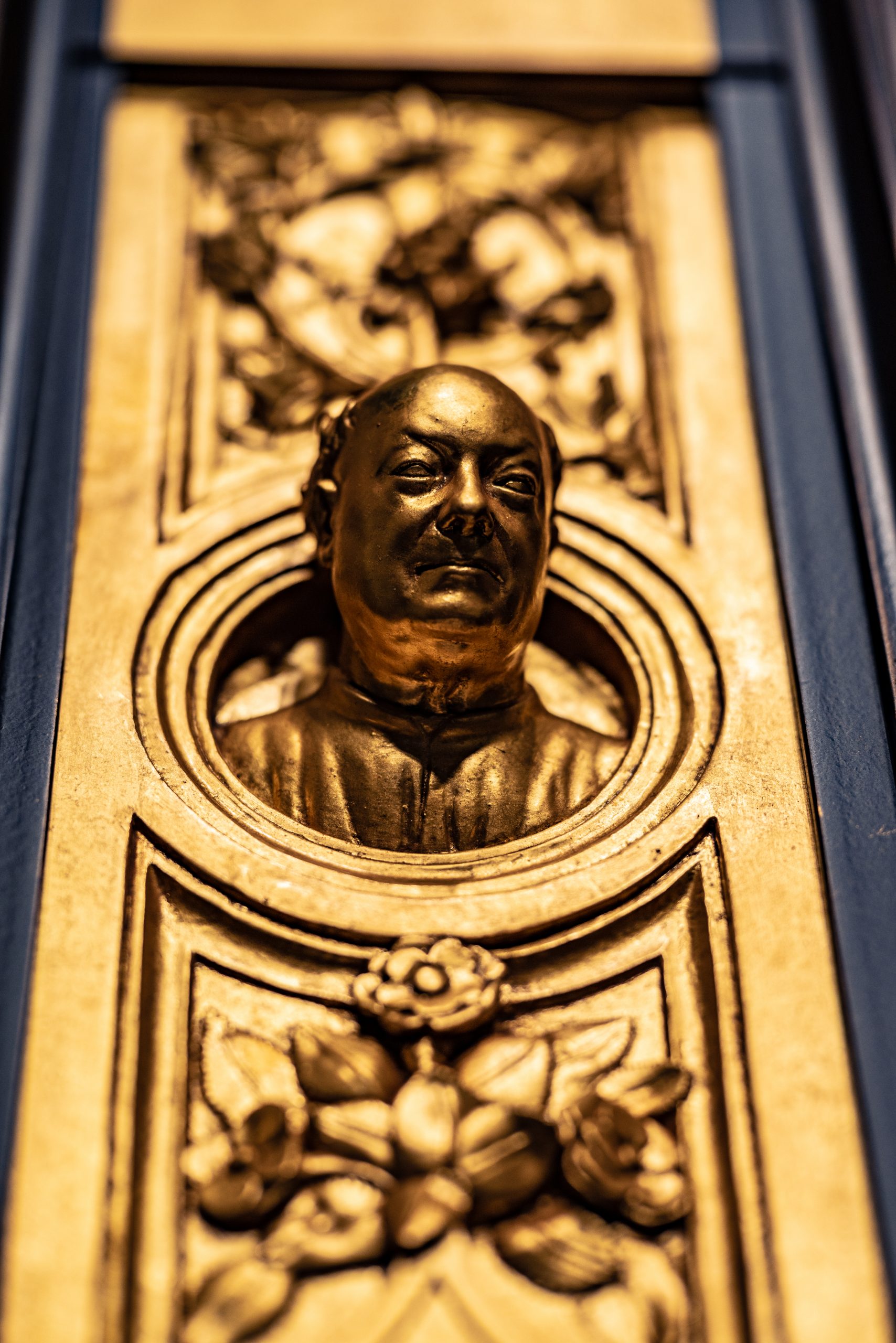
In addition to the 10 large narrative panels, 24 narrow panels and 8 small square ones depict biblical prophets and historical figures (including a self-portrait of Ghiberti).
The exhibition Gilded Paradise: Recasting Lorenzo Ghiberti’s Baptistery Doors opened at the BYU Museum of Art in February. Along with the imposing replica doors, the exhibit includes 3D-printed scans of a few of the panels that visitors can touch. A telescope on the mezzanine level of the museum offers a closer look at the gilded armature from afar.
“Being involved in this discovery and journey has been a total mind-boggling blessing,” says Gray, who marvels at the replica’s transformation “from an unknown condition in the crates to a restored and gilded magnificence.”
“Florence to Hawaii to Provo. . . . That’s a curious, circuitous path,” says Emmer. “It’s required a lot of people to get to this place. The Lord is using all of us in small and big ways to bring things to pass.”