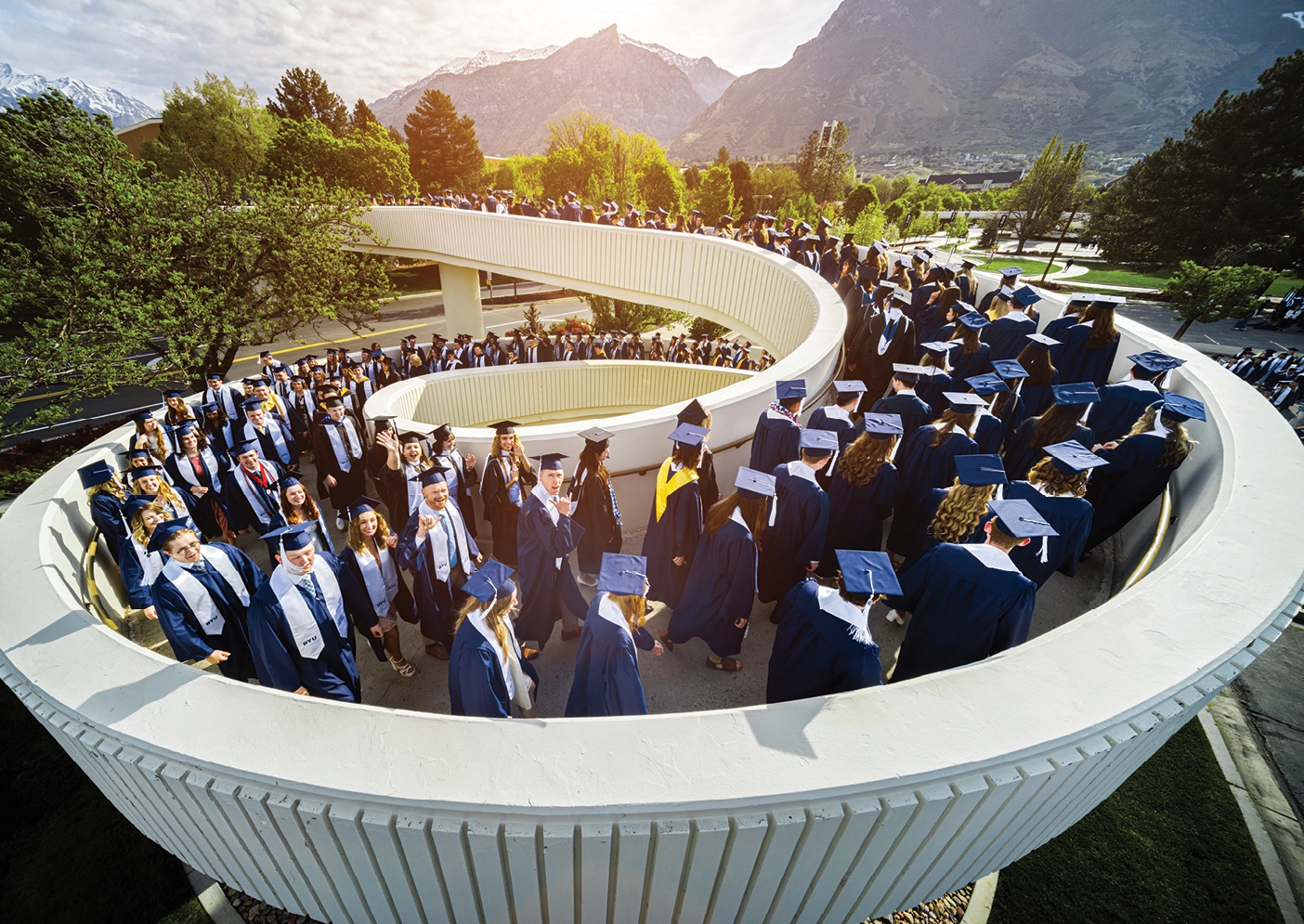
Entering the second half of its second century, BYU sends undaunted graduates into all the world.
Photo by Nate Edwards
I grew up at BYU. My father was a professor, and BYU was the world I experienced—exploring the Bean Museum, licking ice cream at the Creamery, cheering in the stadium on crisp October days. But when I graduated, I built a life far from Provo.
Coming back last June as the university’s spokesperson has given me an unusual vantage point. I’ve been looking at BYU from two directions: from inside an institution I thought I already knew, and from years outside, watching what BYU alumni actually do once they leave this remarkable place.
What I saw while away was this: In cities and towns everywhere, BYU alumni naturally build community. We look for ways to serve, quietly reshaping wherever we land. I’ve watched it happen in neighborhoods and school boards and hospital corridors and church congregations from one coast to the other. It’s the dual heritage of the university at work.
In the 2021 university conference, Elder Jeffrey R. Holland (BS ’65, MA ’66) titled his address “The Second Half of the Second Century of Brigham Young University.” As we close our 150th anniversary year, that title feels like a commission. The second half of the second century has begun, and we turn our focus from what BYU has been to what it is becoming.
This is what President C. Shane Reese’s (BS ’94, MS ’95) Becoming BYU initiative presses toward—faculty, staff, students, and alumni alike striving for our prophetic potential.
“If we cannot look to you to change the world, tell me to whom we should look.”
—Jeffrey R. Holland
President Dallin H. Oaks (BA ’54), who has known this university as student, president, and now prophet, expressed his conviction plainly: “I firmly believe that it is the destiny of Brigham Young University to become what past and present prophets knew it could become. With the consecration and leadership of this community, BYU ‘will become the great university of the Lord—not in the world’s way but in the Lord’s way.’”1
Not in the world’s way. The evidence of BYU’s uniqueness I saw most clearly during my years away wasn’t BYU’s rankings or research output—it was its people. I saw graduates who moved into their communities with a peculiar orientation outward, who didn’t ask what they could get but what they could do.
Elder Holland put it plainly: “Go out there and light a candle. Be a ray of light. . . . If correcting all the world’s ills seems a daunting task, so be it. Go out there and be undaunted. If we cannot look to you to change the world, tell me to whom we should look.”2
This clear call to action falls to nearly half a million alumni—in every profession, community, and corner of the world. The “beacons of light” that BYU celebrated this sesquicentennial year were more than a metaphor. They describe what this university sends into the world with every graduating class. The light kindled on campus was never meant to stay there.
BYU has spent 150 years preparing people to make wherever they end up better. The next 50 years of that story, the second half of a century that prophets have spoken of with unmistakable expectation, will be shaped by what its alumni do with what they received at BYU.