




An alum has combined his many talents to teach public safety in Africa.
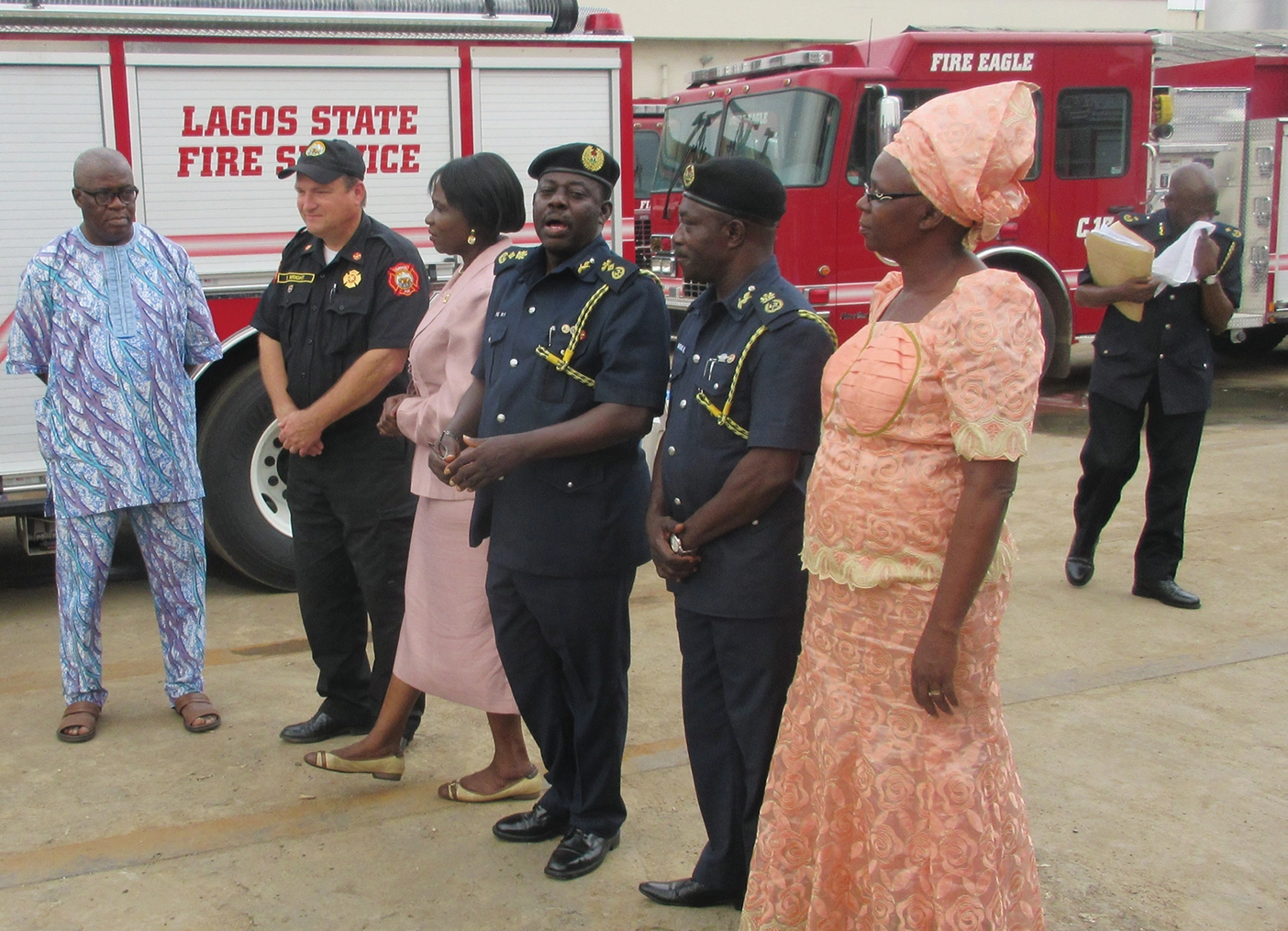
Edward A. Wright (BA ’86) shook his head. He knew that simply dropping off 34 fire trucks in Lagos, Nigeria, shaking hands, and leaving would never work. A transactional approach to delivering $16 million worth of firefighting equipment from the Pacific Northwest would fail spectacularly. To meet the needs of Lagos, a diverse and complex city—one of the most densely populated on earth—the 2015 US-government-supported project required the right training and localization.
So Wright, a former US Marine, a firefighter, and a professional communicator turned international public safety training specialist, took it upon himself to travel to Nigeria in advance, study the challenges, and find funding so the team’s efforts could be truly transformational. This included guiding organizational and structural changes to Lagos State Firefighting and providing technical training and other mentoring to make it all sustainable. It worked.
“It may only have made a dent in the country’s infrastructure needs,” Wright says, “but it’s a model that can be shared.” And the Lagos public safety officials Wright mentored are now mentoring others.
Wright’s practical fire and medical experience, political and communications savvy, and desire to serve had previously led him to Uganda, with the ambitious goal of helping unite emergency services across the nation.
He calls this work more than a career. “It is also spiritual,” he says. “I look at it the way King Benjamin described it: ‘When ye are in the service of your fellow beings, ye are only in the service of your God.’ That has a profound meaning to me because I’ve committed my life to serving in fire departments, ambulances, and working as a medic or firefighter.”
BYU was fundamental in shaping Wright’s service-oriented career. He had already been a Marine, firefighter, and missionary in England when he stepped onto campus in the early ’80s. “I was like a lot of students. I didn’t know what I wanted to do or who I was,” he says. “But I had a family and needed to figure it out.”
Double majoring in public relations and journalism, Wright was mentored by PR professor Raymond E. Beckham (BA ’49) and journalism professor P. Alf Pratte (BS ’62, MA ’65). “They saw something in me that I didn’t see in myself,” he says. “They opened my horizons to a very global world.” And, he adds, “BYU helped me establish a life that I think few other institutions could have done. How many other schools really try to build character and a spiritual foundation?”
His BYU experience and the mentorship he received prepared Wright to work on the national—and international—stage. He interned on Ronald Reagan’s presidential campaign, served as communications director for a congressman, and worked in the speaker of the house’s communications office. Time at an NGO associated with the United Nations led to intensive world travel. “My time in DC taught me how politics works at the highest levels,” Wright says. “What I learned there has shaped my career ever since.”
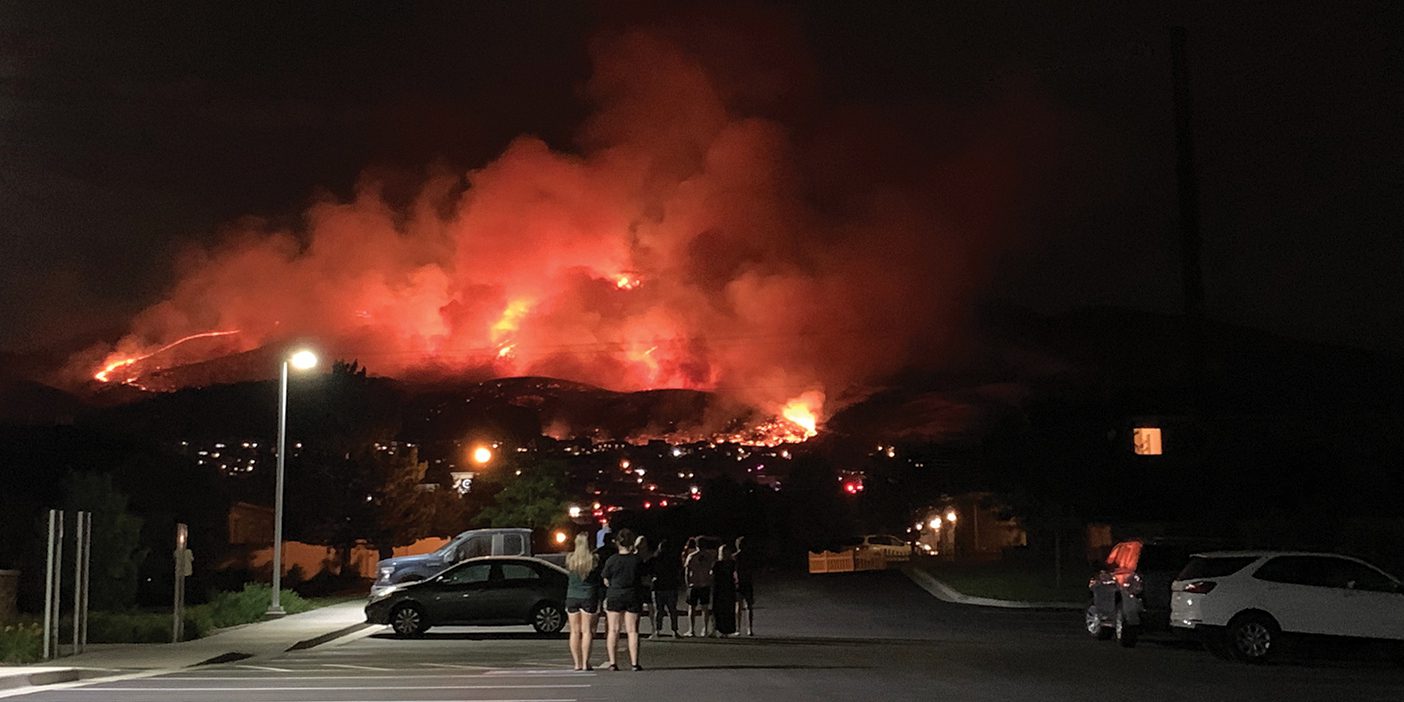
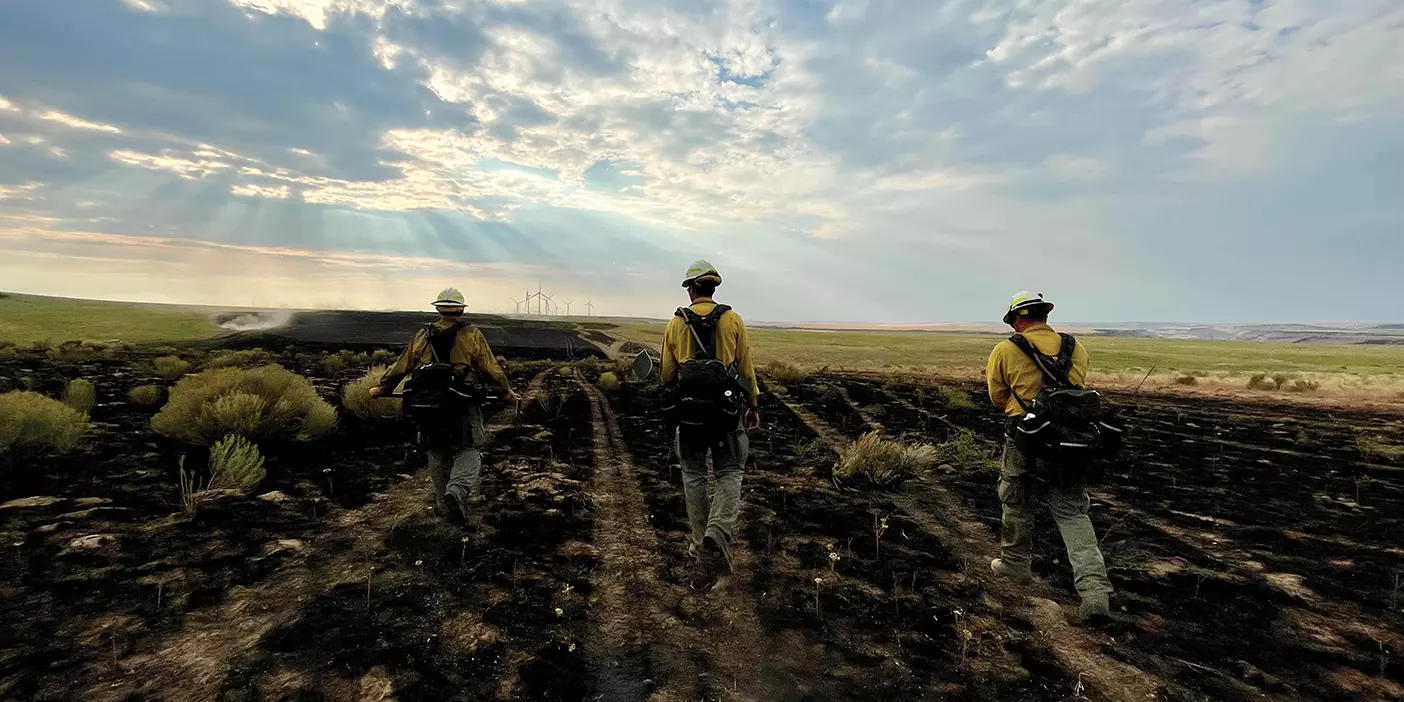
After returning to Washington state, Wright combined his communications background with his skills in emergency services. He fought wildfires, provided emergency medical services, and ran his own firefighting company under a US Forest Service contract. “I never really left emergency medicine or firefighting,” he says. “Sometimes I worked as a volunteer. I built fire trucks and sent crews to Montana, Colorado, Wyoming, or Utah.”
That unique background positioned him to lead the public safety project in Lagos, Nigeria. “It was a very visible project, supported by the US government and a major US manufacturer,” Wright says. “We went in, restructured it, and completed it successfully.”
His connection to Uganda began in 2008, after a brief project in Zambia sparked his interest in African public safety needs. A few years later, he led a training project in western Uganda, teaching 20 people the basics of first response. At the time, he was unsure whether the project would have a lasting impact. “It felt like our efforts were small compared to the need,” Wright says. “But it planted a seed.”
That seed has grown into his current work. “Now, 10 years later, we are working on public safety nationwide,” Wright says. “Leaders are recognizing that you cannot have economic development if you have insecurity—whether it is terrorism, road accidents, or businesses burning down.”
Now Wright works directly with high-ranking Ugandan officials and US government agencies. His role also involves building trust and understanding across cultures. It is challenging, mercurial work. “These are real people living real lives with real problems,” he says. “The highest calling is to use talents God gave me to serve.”
In recognition of Wright’s efforts, the Ugandan Buruuli tribe named him a goodwill ambassador and gave him the title “Prince Begumye,” which means “hold strong, hold fast.”
Looking back, Wright credits BYU with teaching him to adapt. “Expand your horizons,” he advises current students. “Understand the world around you, because it is changing so fast. The experiences you have now may open doors you cannot even imagine.”