




“I saw a girl like me at the store!”
The young girl’s voice was full of excitement as she told her story to occupational therapist Andrew T. Bracken (BS ’99) in 2019. “I couldn’t believe there’s a girl like me.” Which is to say, another girl with arthrogryposis, a condition that prevents elbows from bending and leaves wrists and fingers permanently flexed.
It was a moment of inspiration for Bracken. As a pediatric occupational hand therapist in Utah, Bracken works with kids who have congenital hand differences or traumatic hand injuries, helping them increase mobility and lessen pain. He realized he knew four or five kids with the same condition and could organize more such meetings to build belonging. He just needed a way to connect them with each other.
And so Camp Mighty Hands was born.
Bracken was determined to make it happen, even if he and his wife, Deborah Page Bracken (BS ’96), had to finance it themselves. However, several local companies stepped up to sponsor the camp, and parents of patients and former patients with hand conditions volunteered as camp leaders. Two Primary Children’s Hospital pediatric hand surgeons, Brittany Garcia and Doug Hutchinson, worked with Bracken to fundraise and plan an event that would build skills and allow these kids to get to know each other.

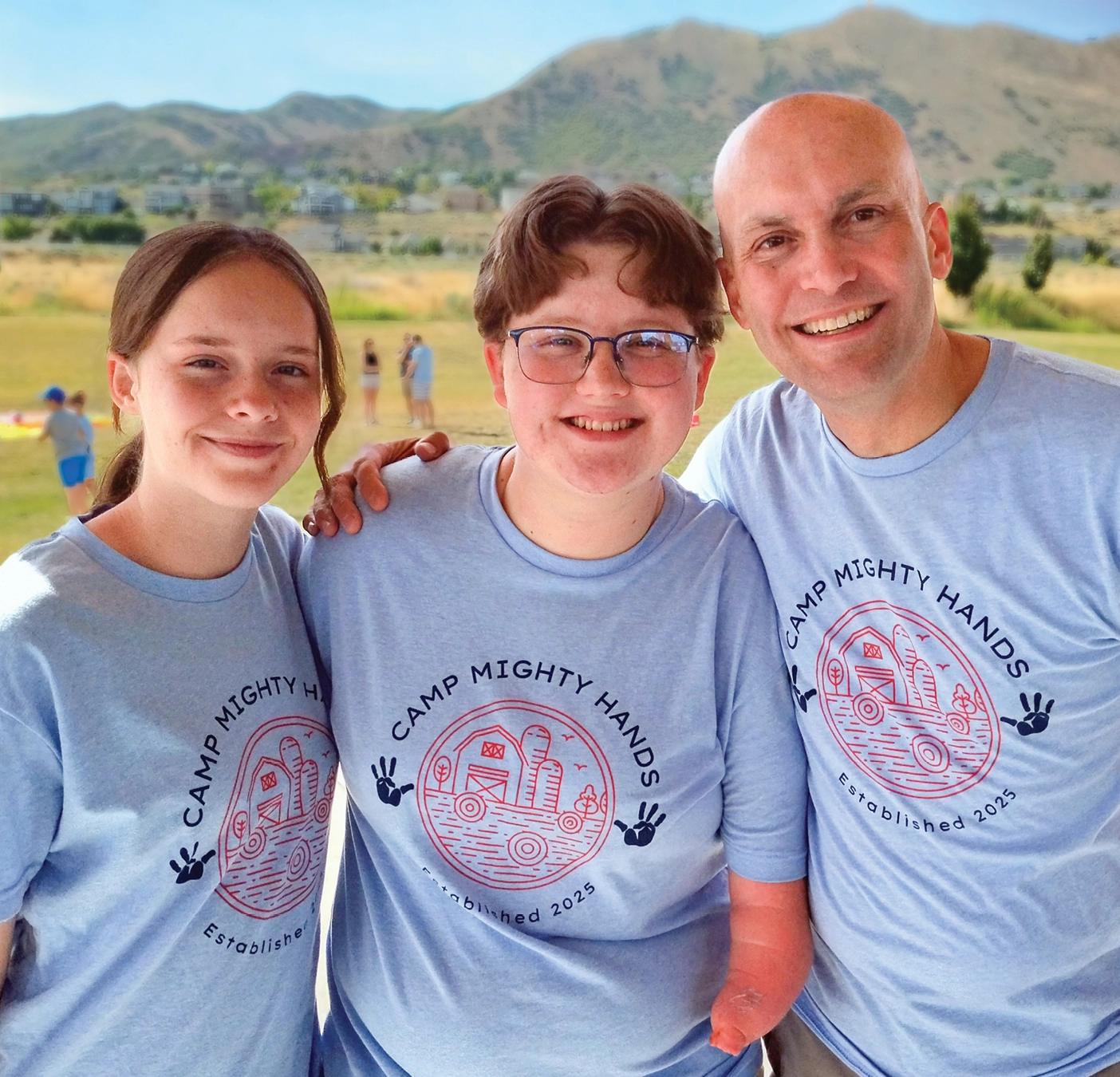
They held the first hand camp at a park, where kids made friends and worked on art projects—leather stamping, face painting, and a butterfly craft.
Several kids told Bracken the same thing: they’d never met anyone with their same congenital hand condition, but at camp “there were three other kids” with the condition. What’s more, the young children also met young adult volunteers succeeding despite having the same conditions.
One of those volunteers, whose hand function was significantly impaired by an injury, told Bracken that volunteering with the kids totally changed his perspective on his injury. “I now have an understanding of . . . what I can do to turn this tragedy into something beautiful,” he said.
“This camp means so much to my girls,” one mother wrote after attending the camp with her three children who have Apert syndrome, a condition that caused their fingers to fuse together. “Hands have been a big challenge for us, and this camp makes it something to celebrate.”
That was Bracken’s goal: to create an opportunity for “these kids who are different to come, celebrate their differences, and feel like they belong.” After the success of their first hand camp, Bracken is determined to do it every year.
Bracken’s interest in occupational therapy stemmed directly from his experience volunteering as a “candy striper” at Primary Children’s Hospital as a 14-year-old. His mother signed him up, and he was skeptical at first. “Back then,” he recalls, “they were usually girls and would wear striped pink and white aprons.” But that summer, Bracken got more volunteer hours than any other junior volunteer and was declared the “junior volunteer of the summer.” While volunteering alongside occupational therapists working with kids in the rehab department, Bracken thought, “That’s something I could do.”

Decades later, Bracken helps kids develop the skills to do things like write and draw, pick things up, use buttons and zippers, tie their shoes, and ride bikes. “We do a lot of games and play, a lot of bilateral hand activities like stringing beads,” Bracken says. “Kids are motivated by candy, so I’ll put M&Ms down and have them try to pick up and pinch an M&M and eat it.” For Bracken the highlight is seeing kids acquire new skills, “accomplishing these incredible goals” they never thought they could do.
“Kids are so trusting,” he says. “They’re so loving. They’re so eager and willing to work with you. My interactions with kids and their parents bring me so much joy.”
When he’s not planning hand camps, Bracken serves in an alliance to provide poor and underserved children and adults in Bolivia with free hand care. In Bolivia Bracken met a young musician who was born with a duplicate thumb, making it difficult to play the guitar and piano and to perform manual labor jobs to provide an income for him and his family. After the young man received hand reconstruction surgery, Bracken worked with him until his hand was completely functional, allowing him to finally play the guitar with ease.
Despite all he does, Bracken says he’s “just a regular person like everyone else, trying to lighten others’ burdens and bring a little more light into the world.”
He doesn’t differentiate between his career and his spiritual calling to serve. “For me, it’s all one,” he says. “I am a disciple of Jesus Christ.” And in both cases, he’s “[lifting] up the hands which hang down” (Heb. 12:12).