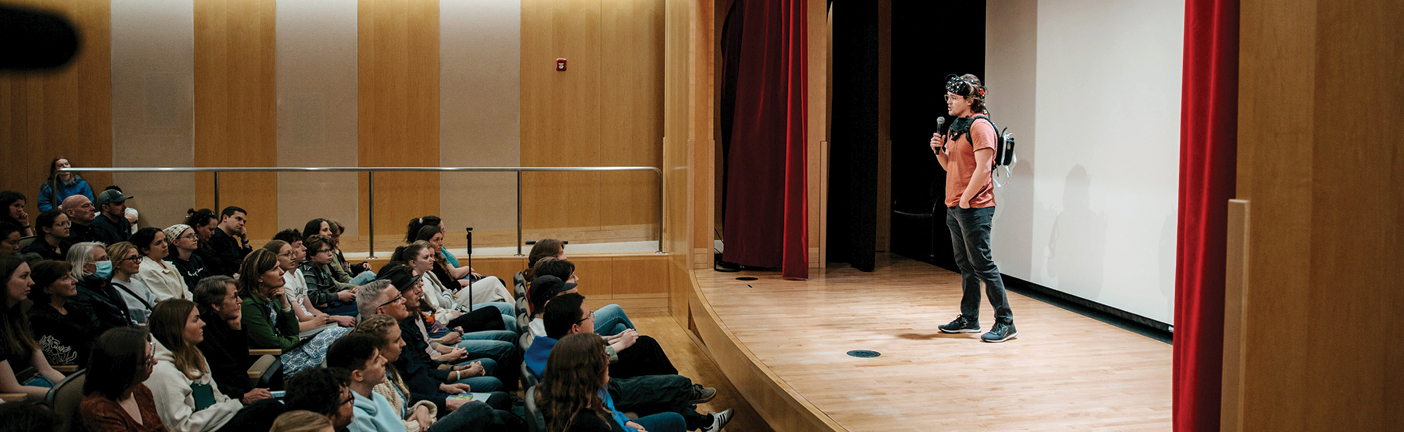





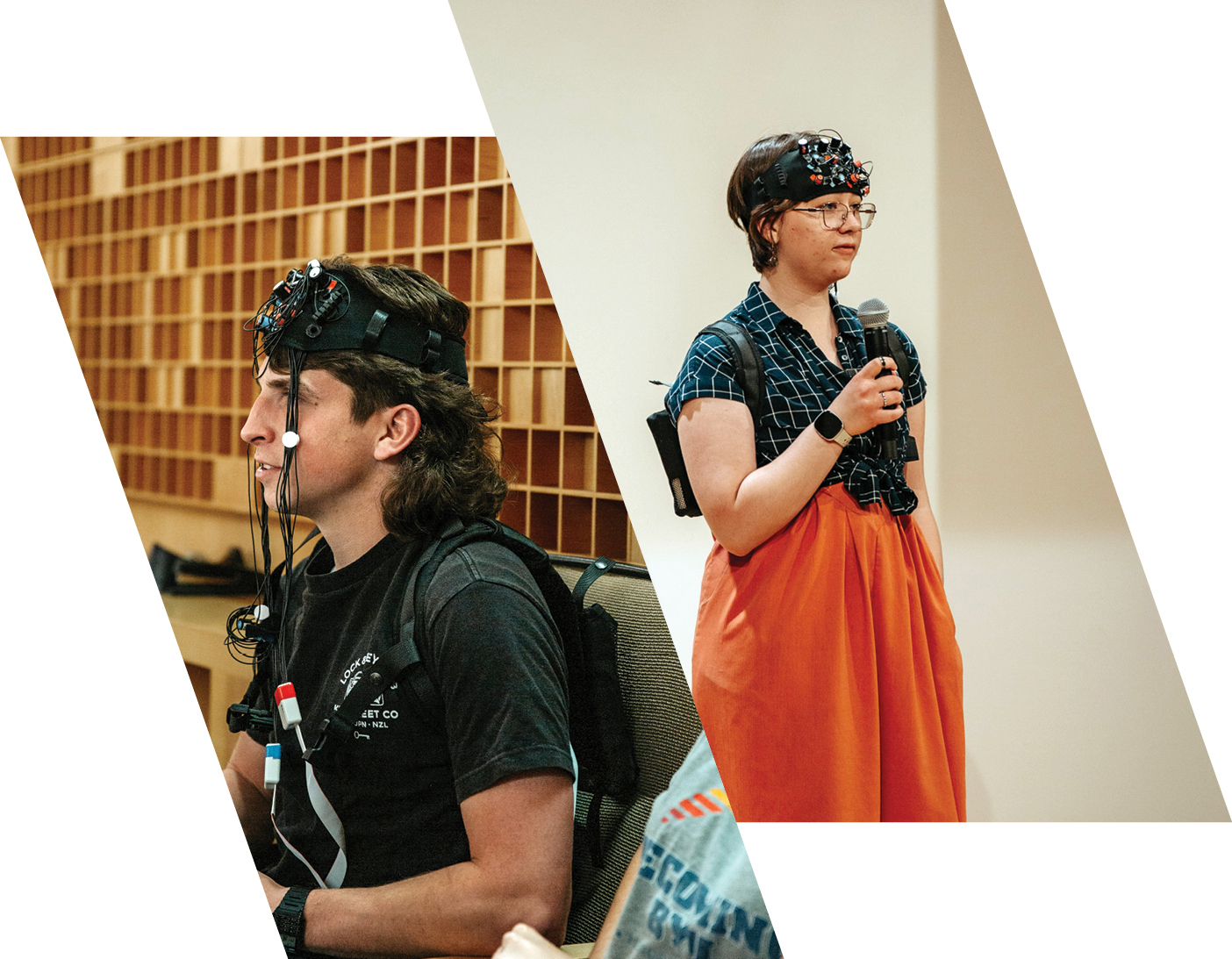
“I was going to be social this year,” said Miriam Spaulding (’27), standing on a simple stage in the JFSB before a packed audience. She was wearing a brain-scanning device, which resembles a bulky hairnet. “I simply wasn’t going to let anything get in the way of that. . . . But then the noises came.”
Spaulding, a senior studying communication disorders, was recently diagnosed with autism and sensory hypersensitivity. “Sounds, lights, and smells that are normal for you are too loud, too bright, and too much for me,” she explained, so a backyard church activity became a sensory obstacle course. “I could feel the hot sun beating against my shoulders, and for the life of me, I couldn’t figure out how to join the 9-square game,” Spaulding recalled during an Autistic Story SLAM event on campus. Spaulding shared that, overwhelmed and overstimulated, she left the activity, “but I stayed there at the end of that driveway . . . , refusing to let go of my hope of belonging.”
The storytelling event was part of a larger research project conducted by communication disorders professor Garrett J. Cardon (BS ’04) to study empathy between autistic and neurotypical people—two groups that often struggle to understand each other. At the April event, five autistic storytellers wearing the brain-scanning devices shared vulnerable experiences in front of the audience. A few listeners also wore brain scanners. Cardon and his team of student researchers are analyzing whether brain activity syncs up between storyteller and listeners—“neurophysiologic evidence of connection.”
Cardon’s research finds that autistic people and neurotypical people have similar needs and similar feelings about those needs, but the context, intensity, and frequency of their feelings toward those needs might be different.
Garrett Cardon
“In most cases, where there is empathy, things get better.”
“When someone can’t participate in something that seems normal,” says Cardon, “we often think that they’re being unreasonable.” But Cardon explains that realizing our needs are similar to someone else’s underlying needs—like belonging, independence, love, acceptance—can make their experience more relatable.
“If somebody says, ‘This is something I need,’ then it’s easier to recognize how deeply they must feel about it, whether you completely understand it or not,” adds research assistant Jenna K. Page (’27).
Cardon’s research is ongoing, with plans to continue the study in different parts of the country, but preliminary findings show that audience members felt more connection to the autistic community after listening to the storytellers.
“In most cases,” Cardon says, “where there is empathy, things get better.”