
6 Presidential Reflections

In celebration of BYU’s 150th, six BYU presidents came together to discuss the university, its mission, and its influence.
In the Winter 2026 issue
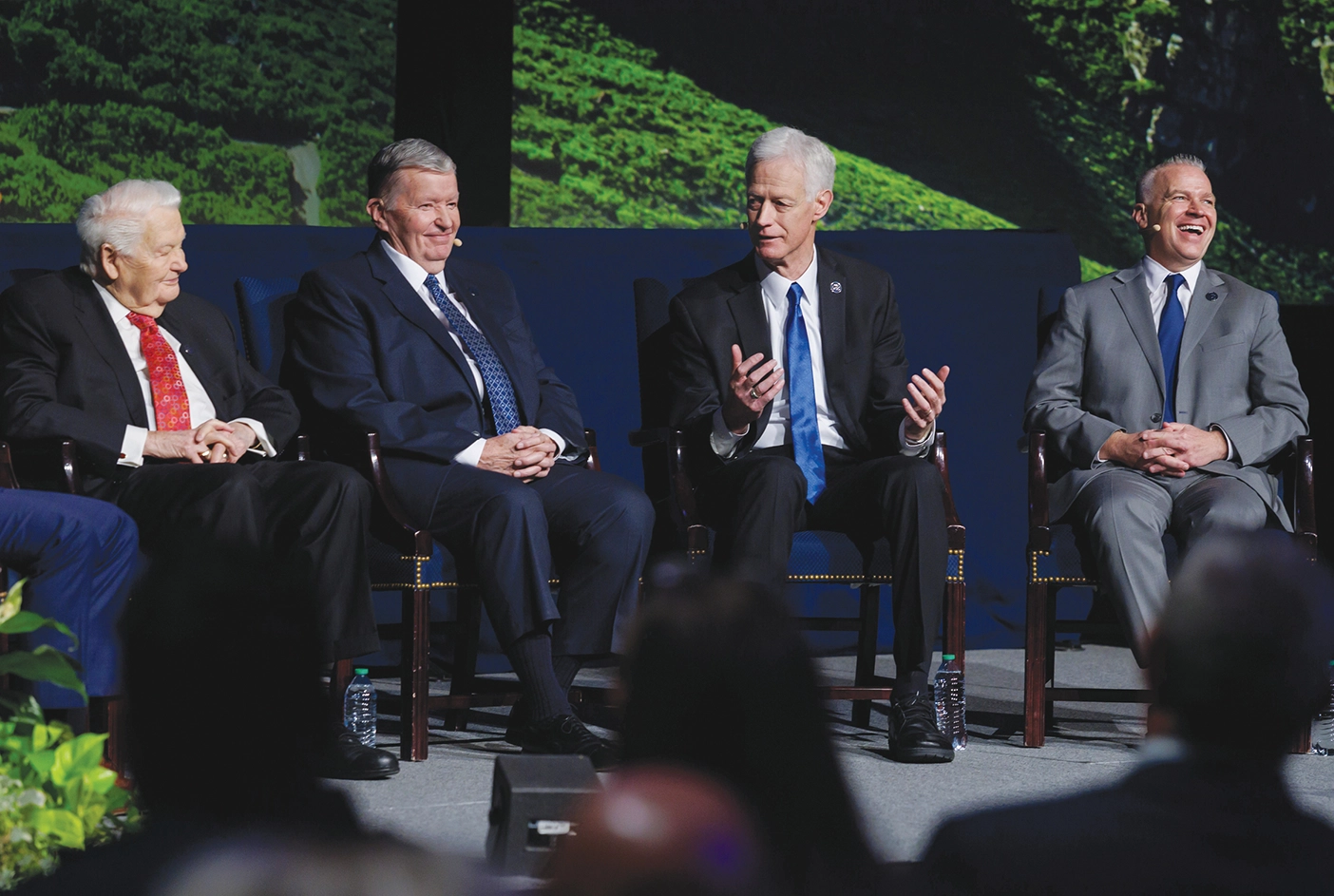
In two separate fall 2025 events, six of the last seven BYU presidents reflected on the university’s meaning in their own lives and its impact on the world. These comments are excerpted from a conversation between Presidents Dallin H. Oaks (BS ’54) and Jeffrey R. Holland (BS ’65, MA ’66) in Salt Lake City and a panel discussion at a special forum in the Marriott Center featuring former BYU Presidents Merrill J. Bateman, Cecil O. Samuelson, and Kevin J Worthen (BA ’79, JD ’82) and current BYU President C. Shane Reese (BS ’94, MS ’95).
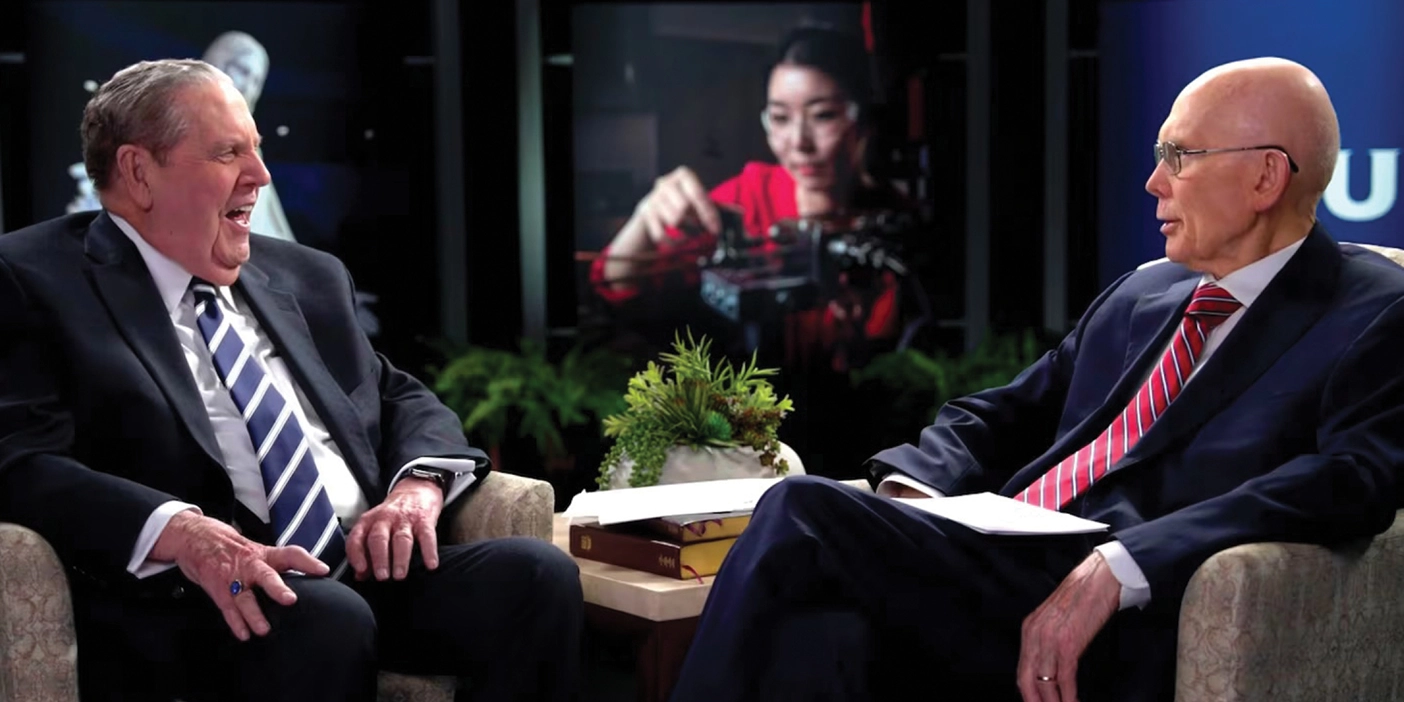
A Memorable Teacher
“I am profoundly grateful to BYU for teaching me what an education was. . . .
“The freshman English class I had from Orea B. Tanner was number one as I look back on the significance of introducing me to education—how to read, how to write, how to judge, and how to use my time in the learning process. I look at that wonderful freshman English teacher as number one in my undergraduate experience. . . .
“I know that BYU is the Lord’s university because it was established by a prophet, it has been carried on with prophetic leadership to this day, and it places the highest priority for its students and its faculty and its administration and its position in the community to furthering the ideals, the teachings, and the values of the gospel of Jesus Christ. That’s what BYU means to me.”
—Dallin H. Oaks
Life-Changing Impact
“My life was changed [by my BYU experience] like a tsunami. . . . I am bold to say the two decisions I made that changed my life forever were to serve a mission and to enroll at Brigham Young University. . . .
“When I was inaugurated, I was at the inaugural dance with Pat. . . . I looked out the east windows of the Wilkinson Center, where the dance was being held. I looked up on the hill, and the Y was lit. . . . And my sweet little wife looked up at me and said, ‘They’re lighting that for you.’
“And I just wept . . . [over] a place that I loved that much, and a place to which I owed that much, and the friends that I’d made there that I loved so much. But I just wept over that lit, outlined Y on the hill—and it still means that to me.”
—Jeffrey R. Holland
A Temple of Learning
“In the year 2000 the Palmyra New York Temple was dedicated. . . . I asked President Gordon B. Hinckley if the service could be shown in the Marriott Center. Although there was some concern that it would be difficult to feel the Spirit during the service in this large space, he granted permission.
“Students with recommends were asked to be in their seats 30 minutes before the meeting began. I arrived early and took a seat on the floor. As I entered this space through one of the tunnels, I immediately noticed extreme quiet in the room. There were no sounds. There were no whisperings. Almost every student had a set of scriptures, and each was quietly reading or pondering the events of the next two hours. A quiet, reverent attitude prevailed throughout the dedication. . . .
“Following the closing hymn and prayer, the Holy Spirit pervaded every corner of this building. . . . I then approached the microphone and excused those in attendance to return to their classes. The few of us on the floor stood and waited for the audience to leave, but no one moved. After another minute, I went to the microphone and again invited those in attendance to return to class. Slowly, quietly, people rose and left the building.
“It was one of the great spiritual moments of my time at this university. This building became an extension of the Palmyra Temple for the two hours of the meeting.
“Brigham Young University is a great university, but, more than that, it’s a great temple of learning.”
—Merrill J. Bateman
Honoring a Prophet
“Early in 2004, I was approached by three of [BYU’s] most loyal and generous supporters—Jack Wheatley, King Husein, and Ira Fulton. They shared great enthusiasm for the notion of a new building [for alumni, friends, and visitors], and they then offered to raise all of the money for the project. . . . They had one condition, however, and that was that the building must be named for the prophet at that time, Gordon B. Hinckley. . . .
“There was a firm policy to not name facilities for living Church leaders. After many prayers and a few sleepless nights, I raised the matter with President Henry B. Eyring, who was then commissioner of the Church Educational System, . . . [then] with President Hinckley’s counselors, President Thomas S. Monson and President James E. Faust. . . . They listened but gently said that . . . I needed to present the matter to [President Hinckley]. . . .
“With great reluctance and many . . . questions, President Hinckley said we could present the matter to the board of trustees and see if they would approve it. Of course, the board’s approval was unanimous and enthusiastic. . . .
“When word of approval became public, there was great excitement, with many wanting to contribute. . . . More than 70,000 individuals . . . donated to the project—including thousands of students and alumni.
“With the blessings of heaven and the very hard work of many, we were able to break ground for the building on June 23, 2006: President Hinckley’s 96th birthday. Just [one year later] the building was dedicated. I don’t have enough fingers and toes to count the many miraculous circumstances that made this beautiful addition to our campus possible.”
—Cecil O. Samuelson
Fruits of Gospel Living
“As president, I came to appreciate that if I wanted somebody to be impressed by the university—whether they were donors, whether they were skeptics, whether they were an accreditation team, or whether they were ambassadors who came on campus—I should get them out among the students. . . . As I visited with many of these guests . . . , they struggled to explain what it was they were feeling. They didn’t quite know how to explain it, but they knew they’d felt something.
“On one occasion when I asked a visitor if she had any questions, she said, ‘Do you have a happiness initiative on campus?’
“I said, ‘A what?’
“She said, ‘A happiness initiative.’
“I said, ‘No; explain.’
“And she said, ‘Well, all of the students seem so happy. I’ve never been at a university where the students are so happy. How do you explain that?’
“I gave what I think is maybe the second-best answer that I could have come up with . . . : ‘This is just the way they are. Before we have anything to do with them, they’ve had 18 years of training in their homes. They just come this way.’ . . .
“It was about two hours later that it dawned on me that I had missed the most obvious missionary opportunity in the world. When she said, ‘Is this a happiness initiative?’ I should have said, ‘Yes, we call it the plan of happiness. And we can arrange for a couple of our students to visit with you, and they can explain everything about the plan of happiness.’
“I came to appreciate that . . . visitors were feeling . . . the fruits of gospel living manifested in the lives of our students.”
—Kevin J Worthen
Founding Characteristics
“If you study the people who have had a hand in the founding of this institution, all of them shared some basic characteristics. . . . That you [students] can develop those same characteristics is what I hope and pray for you who are going to carry this flame of BYU as we stand here in the middle of the second half of our second century as a university. . . .
“The first of the defining characteristics is that those people had an incredible sense of gratitude for people who made a difference in their lives. Whether that person is your elementary school teacher, a sibling who inspired you on your path to learning, your parents who gave you a love for learning, or a faculty member during your time here at BYU. . . .
“The second is . . . a clear sense of the mission of this place. . . . It’s not just the statement of our mission that is important. . . . If there is one hope, one aspiration, that I have for all of you as you enter our doors, it is that you can see yourself in our mission. . . .
“And last, something that was absolutely common to every one of the people who have had an influence on Brigham Young University is that they loved our Master, Jesus Christ, and had a deep desire to serve Him. We hope that you leave here as committed disciples of Jesus Christ.”
—C. Shane Reese
Feedback Send comments on this article to magazine@byu.edu.