






By Grant Madsen
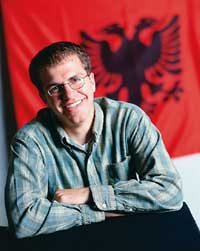 When a young Ryan G. Stewart learned that his junior high school band had too many trombonists, he decided to switch to a different instrument—the tuba.
“I wanted to do what nobody else did,” says the BYU elementary education major. “That’s always been a quest for me.”
As evidence for his claim, the New Jersey native can offer plenty of examples—African drum classes in fourth grade, big genealogy projects at age 12, and a pet-store job he took because he felt sorry for the caged puppies. “I wanted to liberate them,” he says. “I got the job so I could let them run around freely in the store.”
His quest for singularity hasn’t ended. While many of Stewart’s peers were planning their 1999 summer vacations, he was making plans to go to war-torn Kosovo to help ease refugees’ suffering.
Stewart, who served an LDS mission in Albania from 1996 to 1998, knew he had to put his schooling on hold last year when he saw the plight of ethnic Albanians. “As I watched the news and read the papers, I kept imagining people I knew being involved in the crisis. I knew these people; I experienced their culture, spoke their language, and felt a part of them,” says Stewart. “It was absolutely heartbreaking for me to hear of these tragic experiences.”
Other people might feel similar heartache without taking action, but Stewart got on the Internet and began sending his resume to relief agencies. His journey began when Relief International (RI), a nonprofit agency that provides emergency relief to communities worldwide, agreed to send him to the Balkans in May 1999.
Originally assigned to develop formal education programs for refugee camps, Stewart quickly found himself the site manager of a 1,700-person refugee camp in Berat, Albania. His responsibilities spanned just about every sector of relief work—health care, education, food distribution, shelter, management, and agriculture. “I came home each day as tired as a dog, but feeling as satisfied and fulfilled as could be,” he says.
Working closely with the Saudi Arabian World Islamic Aid Agency, Stewart organized informal youth education centers in neighboring refugee camps. There, children had supervised play time with UNICEF-donated materials, such as crayons, paper, pencils, balls, and chess sets. Stewart eventually opened an RI office in Prizren, Kosovo, where he worked to provide primary health care to three remote villages. At the same time, he managed a collection center that provided health care, water and sanitation, psychosocial support, and distribution services for 220 displaced Serbians.
“I was involved in everything from manual labor and garbage pickup to negotiating contracts and writing proposals for grants,” he says. “I tried to keep a balance of administrative work, direct involvement with the people, and good old-fashioned manual labor.”
Stewart also worked with the Youth of Prizren, a non-governmental organization, to put together a photo essay called “Photos for Peace.” The project involved teaching photography skills to children from Prizren and leading them in discussions about topics such as peace, love, and cooperation. Then they were given cameras and asked to capture images that expressed their feelings about the war.
“That project really made us think,” Stewart recalls.
Much of his success with this and other projects Stewart attributes to skills he learned at BYU. “At BYU I was able to really fine tune how to deal with people—how to be diplomatic and fair and mediating. Those skills came into play on a continual basis.”
Stewart credits a BYU human development class with helping him understand the way people adapt to their environment, something he witnessed every day in Kosovo. “One of the greatest lessons I learned was that of human resilience,” he says. “I listened to children tell me horrendous stories about dead relatives and witnessing decapitations, but the way they bounced back, you would never know that these children were different from any others.”
Stewart originally planned to stay in Kosovo for a few months and then volunteer as an English teacher in Russia. He changed his mind when RI offered him a paid position through the end of 1999.
“I felt that Russia or any other job teaching English in a foreign land would always be there, but Kosovo was really a once-in-a-lifetime opportunity,” says Stewart, who returned to BYU in January to continue earning his degree.
But now that this self-described non-traditionalist has returned to the student lifestyle, he maintains that his experiences in Kosovo taught him valuable lessons for the future.
“I’ve realized that something as simple as a sincere pat on the back or a hug or listening with love can have an impact far beyond what you realize,” says Stewart. “I’ve learned that I’ve got power to make a difference in the world.”