




By feeding and serving people in need, a BYU grad opens doors of opportunity.
With discolored and broken teeth—the byproduct of a previous drug addiction—Susan had spent years trying to get a job. “Turned down. Turned down. Turned down,” says Brent S. Crane (BS ’93), executive director of Provo’s Food & Care Coalition. But after receiving teeth reconstruction through the Food & Care Coalition’s free dental services, Susan began smiling again. “Her whole countenance changed,” Crane says. “Within weeks, she was able to find a job. . . . And things started to fall in line for her.”
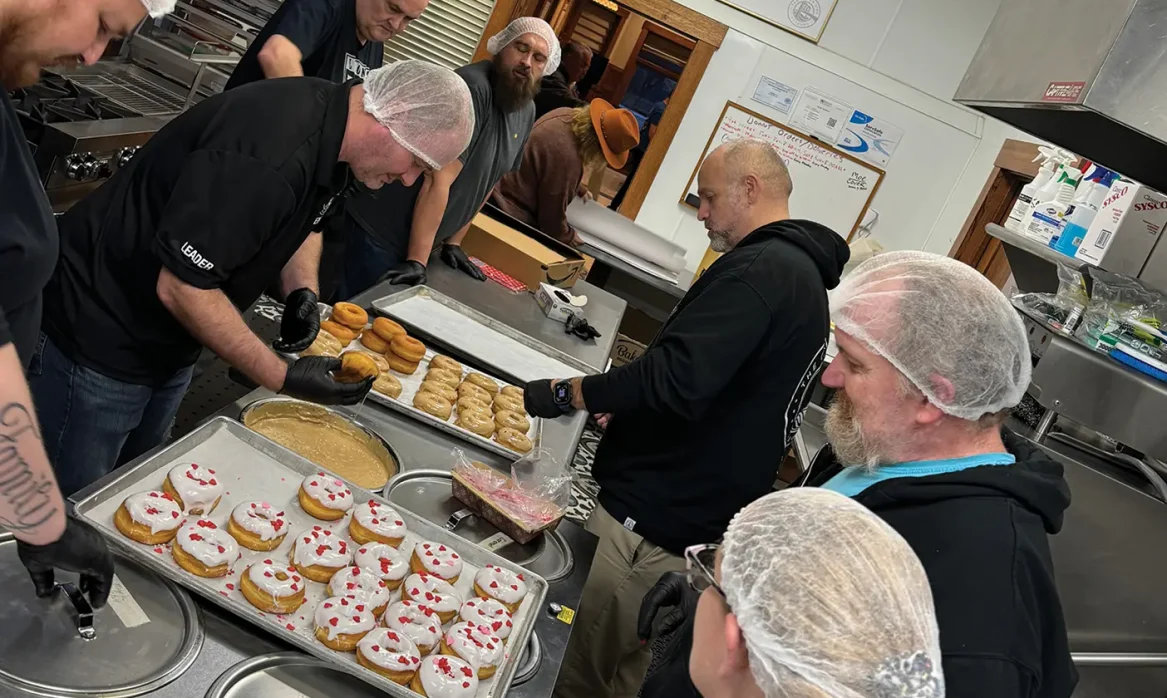
Such are the transformations Crane seeks for every one of his clients and friends he serves at the Food & Care Coalition. Much more than a food pantry, the organization provides an array of services for local unhoused and low-income populations. Crane views the meal program as a “gateway.” Once clients’ food needs are met, they can then focus on the tools they need to get back on their feet and reach their potential.
“We’re addressing the whole person,” says Crane, a BYU family science grad who now sits on the national advisory council for the College of Family, Home, and Social Sciences. Services like free meals, hot showers, housing, clothing, hygiene products, dental and medical care, and more work together to accomplish the coalition’s mission “to alleviate hunger and diminish the plights of poverty.”
The organization has come a long way since Crane was appointed executive director more than three decades ago. “We were in a little roach-infested, two-story, 1,500-square-foot house,” remembers Crane. Later, they transformed an unsightly property for their current location. “The property used to have a rail line right through it, car parts, junk. It was a junkyard.”

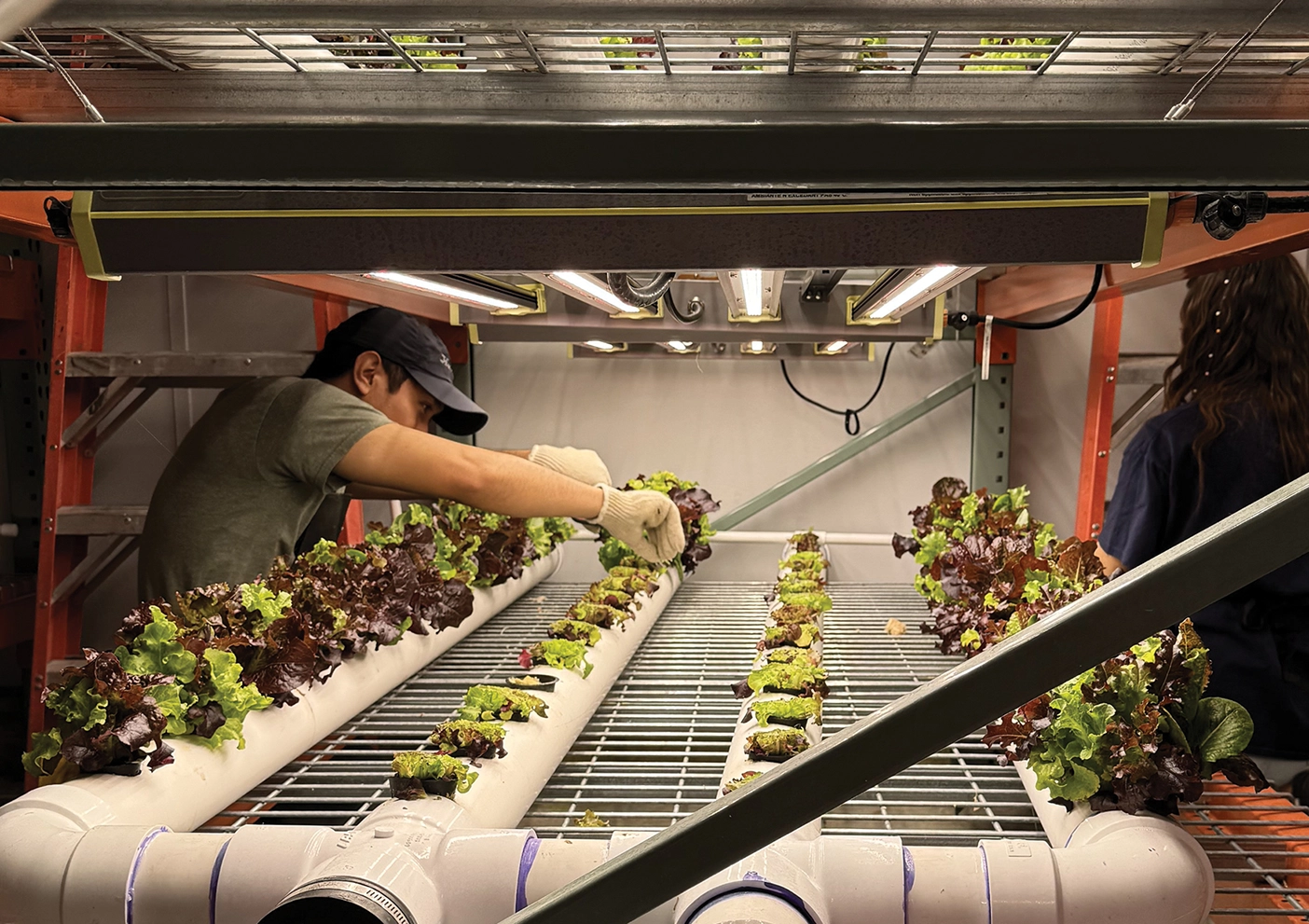
Thanks to the efforts of Crane and a supportive community, today the facility sits on four and a half acres of well-maintained grounds and offers a variety of services right on the campus. “We have 38 micro hotel rooms for shelter, 6 apartment buildings as permanent housing, dog walking areas, and bike repair stations.” With support from BYU researchers, the center recently added an indoor hydroponic garden, which provides fresh vegetables year-round.
Crane remembers the clients’ reactions to one round of improved facilities: “They came in, and they looked around. . . . ‘For us? This is for us?’ They began to see themselves in a different way.”
Crane has also worked to build community involvement—the “coalition” of churches, businesses, municipalities, families, and individuals who support the work. That coalition was first created when local Christian churches gathered and agreed to address these community needs together. Added support from community businesses like Wasatch Behavioral Health and Mountainlands Community Health Center allow clients to get the health care they need right on the campus.
In recent years the number of volunteers—of all ages, beliefs, and backgrounds—can be so high that they have to be turned away—a far cry from when “we had to beg for volunteers,” says Crane. “I love seeing the Hare Krishnas come in one day, Catholics come in one day. What’s even better is when two people of different faiths come in and serve together.”
People sometimes tell Crane that everyone has equal opportunity in life and gets what they deserve. “I politely disagree with that assessment,” he says. In his work at the Food & Care Coalition, he sees the results of inequality every day, how the circumstances people are born into affect the rest of their lives, and how people do the best they can with what they have. He says his work is to “provide opportunity and open doors to a population that may have closed some of those doors themselves or because of opportunities that were never available to them.”
While professional, Crane is far from impersonal in his work. Trying to be “the Lord’s hands,” Crane has invited many clients into his home and to his dinner table. Many have become like family.
He had a particularly close relationship with one client who struggled with seizures. Once a year, the man would have to take a neurological test that required him to arrive sleep deprived. To help him prepare for the appointments, Crane brought the client home with him. “We’d try to play games all night . . . to keep ourselves awake,” Crane recalls. For years, Crane and his family took this friend under their wing. He even joined Crane and his daughters on a Disneyland trip since he’d never been.
Crane’s friend passed away at the beginning of 2025. “He’s my lifeline to heaven,” Crane says.
Noting that “charity . . . is never convenient,” Crane keeps his focus on small gains amid many setbacks. “There are days in this line of work that are hard,” he admits. “There are days when it’s frustrating. There are days when it’s even infuriating. And then there are those days the clouds open and all is well and people find success and people see the light and people improve their lives.”
He says learning to see with God’s eyes can be transformative. “If we can look at that individual that’s struggling with addiction, struggling with mental health issues, struggling with poor choices, whatever it is—if we can see them as God does—we’re going to be far better off.”