Not all children end up treading the same academic or career paths as their parents. But sometimes their journeys are remarkably alike—with traits, interests, and aptitudes passed on like an intellectual inheritance. While such resonances sometimes stem from parents’ intentional mentoring and encouragement, just as often they can be chalked up to coincidence or simply the natural result of a child growing up in the family’s intellectual milieu.
Here are three examples of BYU families in which talents, passions, and purpose echo across generations.
The Next Chapter
After a mother started writing, her daughter unexpectedly picked up the pen.
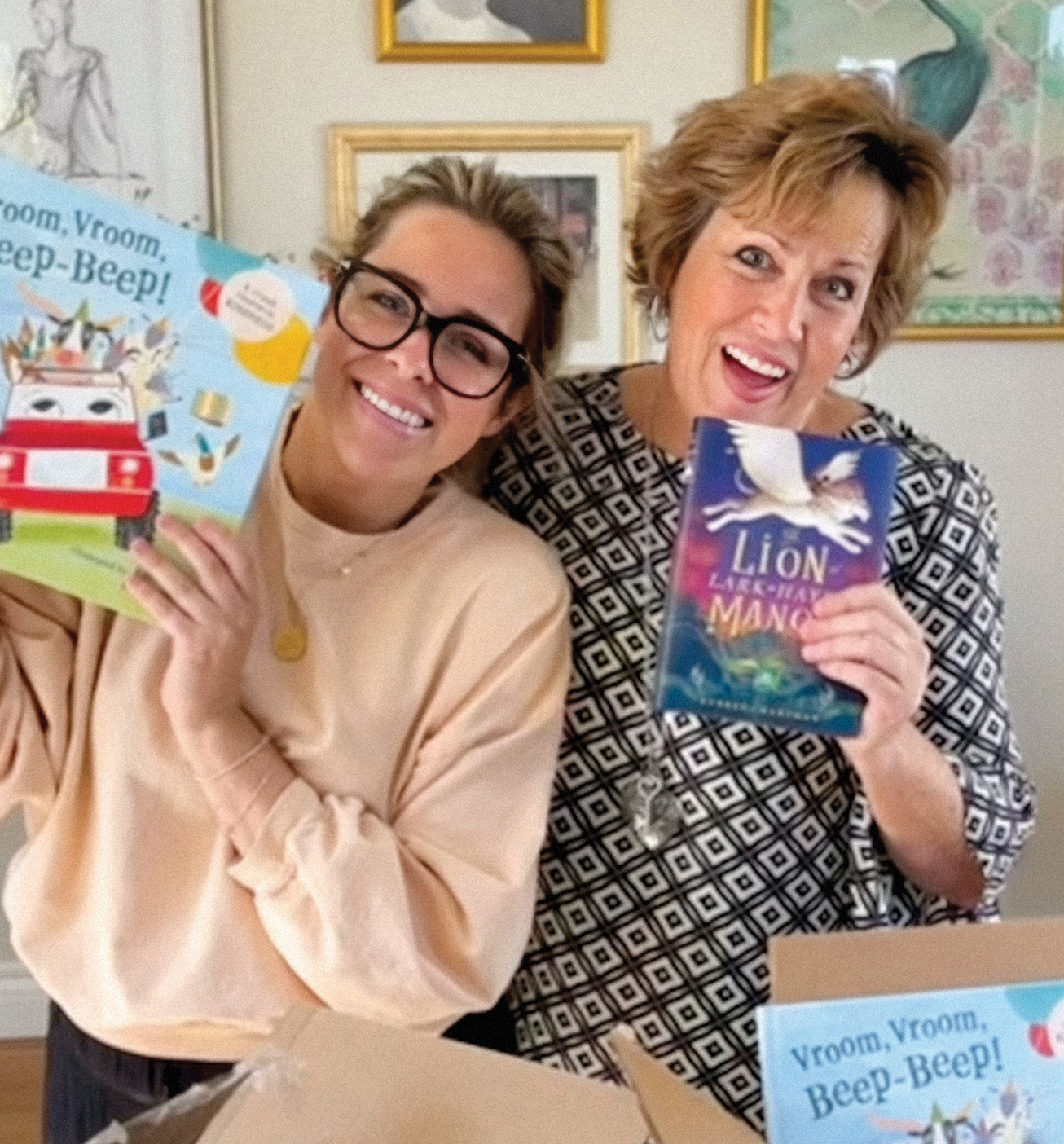
Growing up, Hartman never expected to become a published author like her mother. Photo courtesy Lezlie Evans.
When Aubrey Evans Hartman (BA ’10) got the news that her middle-grade novel The Undead Fox of Deadwood Forest had been designated a John Newbery honor book—one of the highest distinctions for children’s literature—the first call she made was to her mother. “She burst into tears,” Hartman remembers, “because she knew it was a very arduous journey to get there.”
“It was a pretty cool mothering moment,” recalls Lezlie Peterson Evans (BA ’83), who has written and published children’s books for more than 30 years. “You don’t think those things are going to happen when they’re crazy little 2-year-olds running around, but they grow up and they do more amazing things than you could ever dream of.”
Hartman’s heartwarming novel joined her mother’s latest rhyming tale, Goats Afloat, on the Children’s Book Council’s 2026 Librarians Favorites list.
Evans raised Hartman and her five siblings on library books. “We checked out the max amount of books every two weeks; it was 60 books,” recalls Evans. They gave special attention to the books with the gold Newbery and Caldecott stickers. “When it was time to find those books to return them, . . . it was like the world’s greatest treasure hunt.” The Evans family read books in the car. They read in the bathtub. They read at the breakfast table. Amid all the reading, Evans started writing.
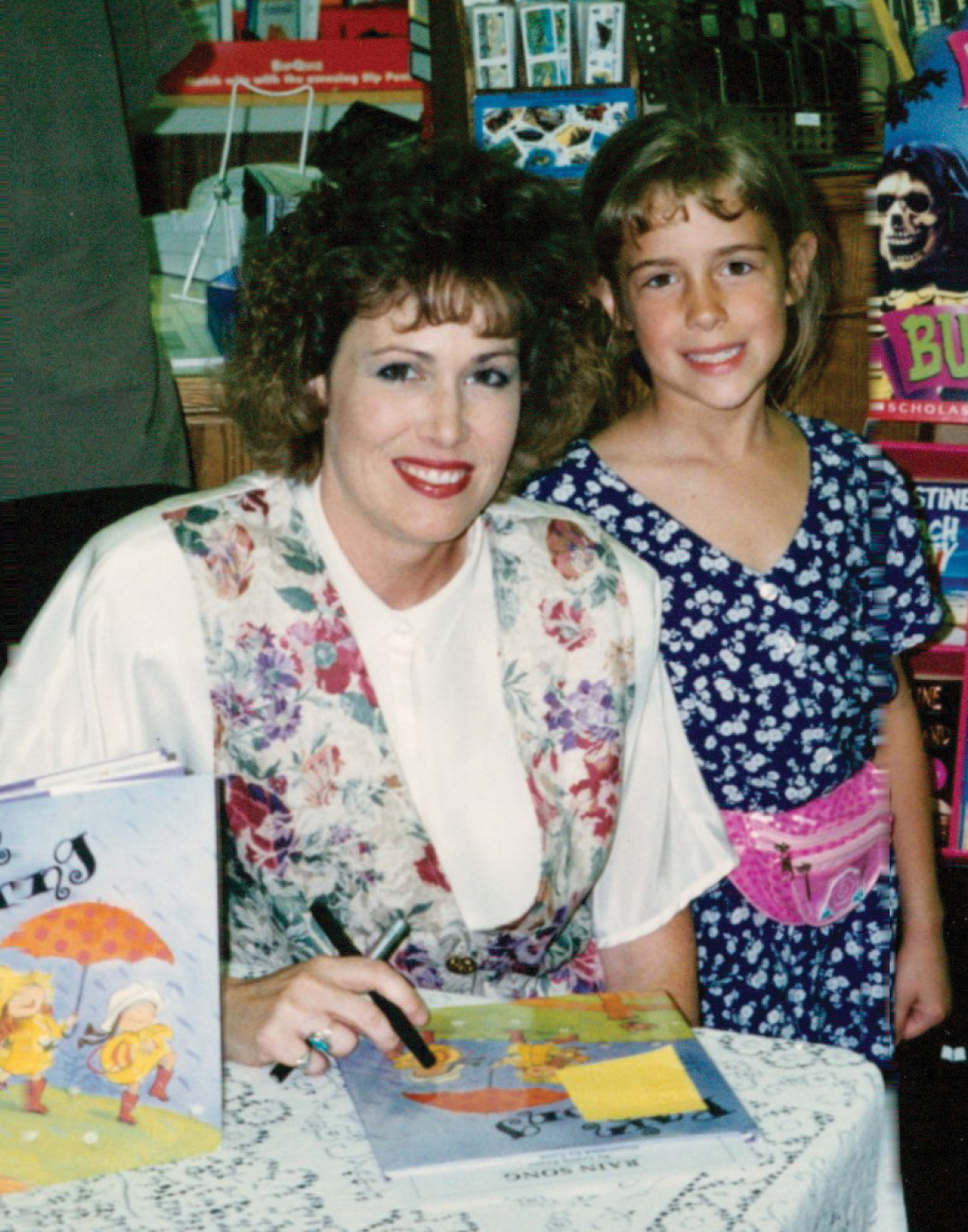
It began on a stormy night, when Evans was awoken by her youngest child. “The lightning was flashing and the trees were thrashing outside my window and the thunder was crashing,” she recalls. “Suddenly these words just started coming into my mind.” She wrote the poem that became her first published book: Rain Song. Since then, Evans has published 13 more picture books.
“You don’t think those things are going to happen when they’re crazy little 2-year-olds running around, but they grow up and they do more amazing things than you could ever dream of.”
—Lezlie Evans
“She would read them to us when they were just still manuscripts,” remembers Hartman. Despite her love of reading, Hartman did not dream of becoming an author. “Of all my siblings, I don’t think my mom would have guessed that I would be her writer,” she says.
Middle-grade novelist Aubrey Hartman (left) and her mother, children’s book author Lezlie Evans, hold copies of each other’s 2023 books. Photo courtesy Lezlie Evans.
After graduating from BYU in advertising, Hartman worked as a dance instructor and felt like something was missing. “I needed a creative outlet,” she says. When her mother suggested she write a book, Hartman was skeptical. But desperate for a new pursuit, she began scribbling away. Despite eight years of revisions and rejections, “writing became my passion,” she says. “Almost like a compulsion, it did not occur to me to not be writing.” Her first novel, The Lion of Lark-Heyes Manor, was published in 2023.
“There’s a lot of rejection involved in the industry,” says Evans. “Persistence is just one of the necessary things, . . . and she didn’t give up.”
Hartman looks to her mother as a guide, cheerleader, and support. “She’s always my first call for anything writing related, and sometimes before I even sit down at my computer, I’ll give her a call just to ground myself.”
Hartman now reads her manuscripts to her own young children. “It feels very full circle,” she says. She recently taught her oldest daughter how to make suggestions and comments on her latest novel draft in Microsoft Word. “I would not be surprised if she also goes into something in publishing,” Hartman says. “It’s really fun to give them that same special childhood experience that my mom gave me.”
An Artful Inheritance
A father and son are crafting and upholding BYU Animation’s award-winning reputation.
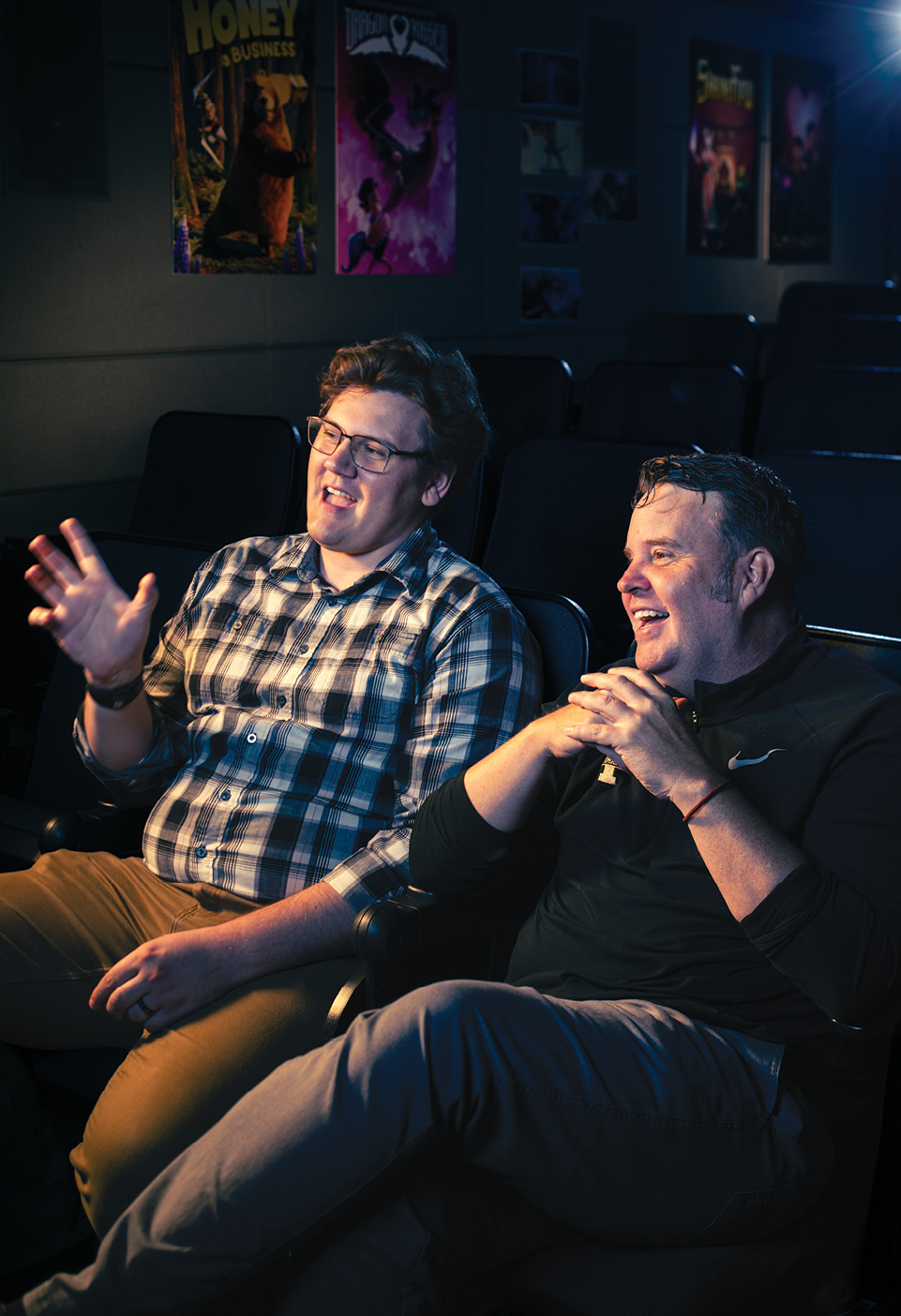
Craig Van Dyke (right) and his son Connor have bonded in BYU’s animation labs over the decades—first as young father Craig labored over BYU’s inaugural computer-animated short, Lemmings. More recently, Craig mentored Connor on another award-winning BYU animated short. Photo by Bradley Slade.
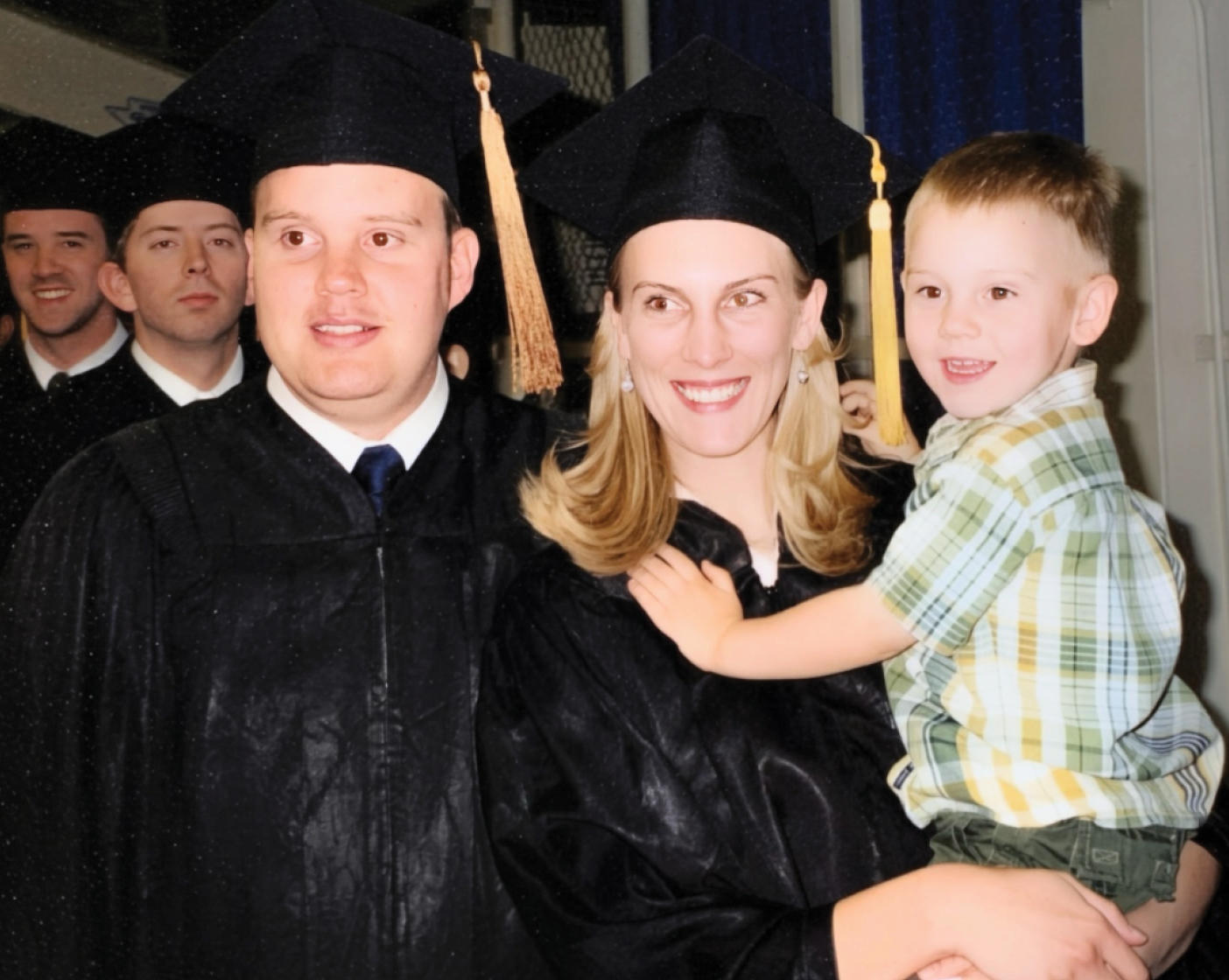
Connor P. Van Dyke (BFA ’25) took some of his first steps in the Snell Building. In the makeshift animation lab, he’d sometimes sit on a skateboard as his father and other students pushed him back and forth between desks while they worked on their film Lemmings.
As the director and producer of the animated short, Craig P. Van Dyke (BFA ’03) would take his turns checking on the movie’s rendering at all hours of the day and night, sometimes rocking young Connor to sleep amid glowing screens. Craig was making history working on Lemmings, the first computer-animated film created at BYU, the output of an innovative industrial design capstone project led by professor R. Brent Adams (’76).
“Back then there was no animation program,” says Craig. “It was just students in a room with really expensive hardware and software,” begging to enroll in figure drawing courses and occasionally dodging security guards for midnight render checks. In 2004 the short won a first-place student Emmy, marking the beginning of BYU’s decades-long dominance.
Craig joined Adams and his Lemmings cohort to advise on the curriculum for a new animation major—not yet realizing he was building something for the young son who so often toddled beside him in the lab.
Connor would go on to earn his own Student Emmy as the director of Love and Gold, the animation program’s 2026 award-winning film.
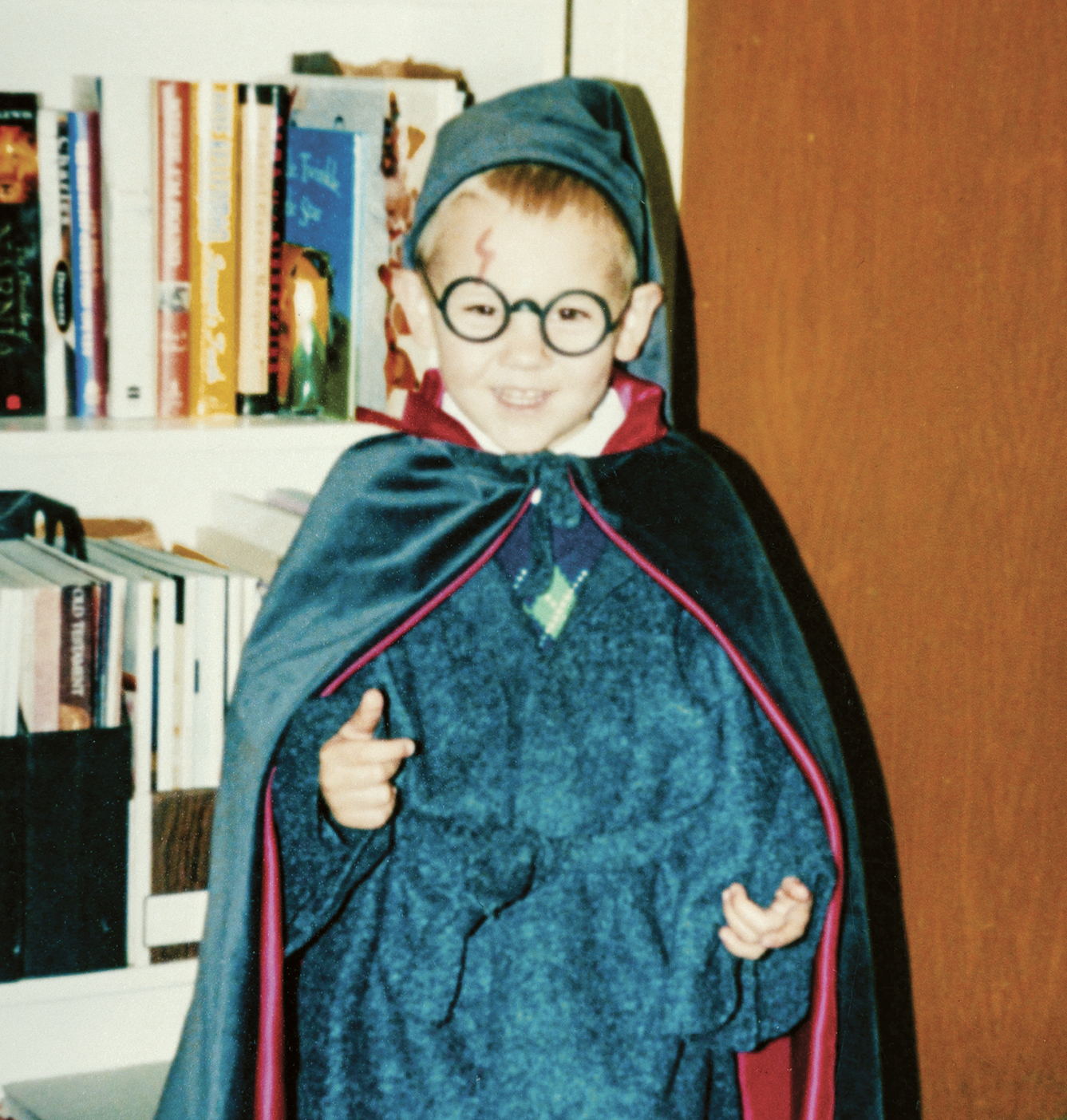
Young Connor spent many hours on campus—and in the animation lab—with his parents. Photos courtesy Craig Van Dyke.
“I’ve never pushed it on him,” Craig says. But with his father’s career at studios including DreamWorks, Disneytoon Studios, and Netflix Animation, Connor showed interest in animation from an early age. “I still remember being able to go and see what he was working on for the How to Train Your Dragon movies,” Connor says.
Drawing came naturally for Connor—“an easy way for me to focus during church,” he says. He was a born storyteller too: “I wrote little movies in my head.” Connor would jot down plotlines and flesh out characters in his sketchpad, refining ideas to run past his friends—and his dad. “My dad was a harsh critic,” Connor says. “But I got a lot better at telling stories. He would give genuine and honest feedback.”
Still, Connor considered art to be a hobby. Then on his mission he had a change of heart and came home intending to apply for a slot in the limited-enrollment animation program. Craig, who by then had returned to BYU as an animation professor, felt some anxiety creep in. “He worried for me because of the intensity and level of skill needed to get into the program,” not to mention the competitive animation industry, says Connor. “But he encouraged me.”
Connor was accepted (no thanks to Craig, who had recused himself), and Craig taught about a quarter of Connor’s animation classes, including the capstone course that produced Love and Gold. “It’s not easy having your dad as your professor,” Craig says, someone who knows “exactly what you’re doing with your time outside class.”
“When we started this program, it wasn’t fully formed, and now our children are coming through. The win was a big deal for me—BYU animation isn’t going anywhere. We’re good for another generation.”
—Craig Van Dyke
In the classroom Craig stepped easily into a mentoring role. “At some point it stopped feeling like I was talking to my dad and started feeling like I was talking to a professor who knew what we needed to do to make our film work.” Craig avoided nepotism and favoritism—Connor had to work, learning his specialty in storyboarding, earning TA positions with other professors, and pitching his capstone film idea for selection by student vote, like everyone else.
“I was pretty hard on him,” says Craig. “But in reality I’m hard on all of them. It sounds trite, but all these students feel like my kids, and we treat them like family.”
Connor graduated in April 2026 and is doing freelance work while his wife, Baylor Williams Van Dyke (’27), finishes up her own capstone animation film.
When Connor and his classmates took home their Student Emmy, “I’m pretty sure I screamed the loudest,” Craig says. “It was a double whammy of being both his dad and his teacher.” It was a full-circle moment: “When we started this program, it wasn’t fully formed, and now our children are coming through. The win was a big deal for me—BYU animation isn’t going anywhere. We’re good for another generation.”
Watch an interview with Connor and Craig Van Dyke on YouTube.
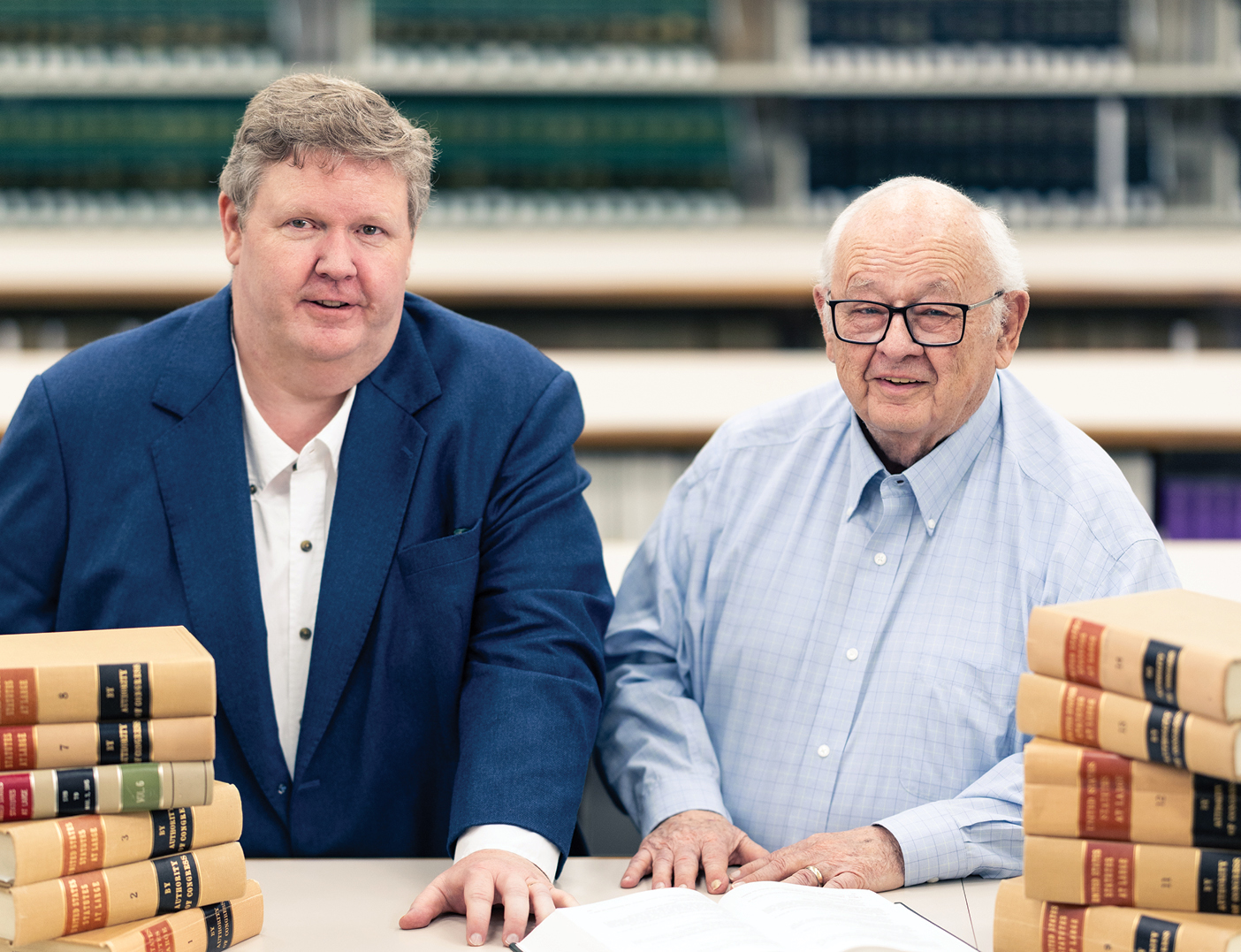
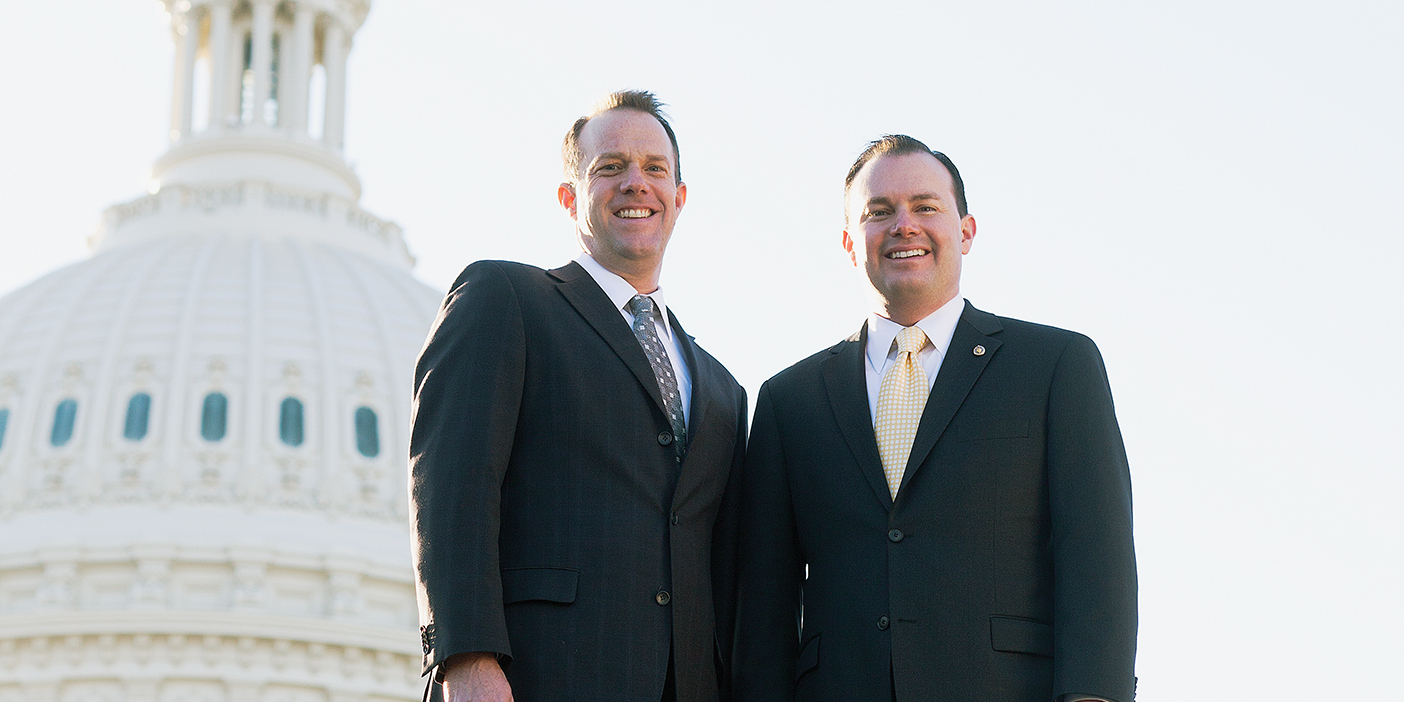
Three generations of Popes have studied and taught economics and political science at BYU. Jeremy (left) followed in the footsteps of his father, Clayne, as an American Heritage teacher. Photo by Bradley Slade.
When as children Jeremy C. Pope (BA ’97) and his sister, Hilary Pope Erickson (BS ’98), asked their dad for 50 cents to buy something, the money—if it came—typically came with a lesson in economics. Opportunity cost was a common theme. Other times it was incentives or maybe the power of free markets. That’s what happens when your father is Clayne L. Pope (MA ’72), a BYU economic historian and later dean of the College of Family, Home, and Social Sciences.
While Hilary rolled her eyes at the unsolicited lectures, they landed better with Jeremy, who showed a budding interest in social sciences and history. His interest had started early, when Jeremy was 4 and his dad accepted a summertime sabbatical appointment at the College of William & Mary in Williamsburg, Virginia. As part of the gig, the family got free passes to the adjacent Colonial Williamsburg living history site. Jeremy was entranced. “Thomas Jefferson and George Washington and the guy out giving news of the revolution became real people to him,” Clayne says.
“We are consumers of what’s going on in the world. We need to understand so that we can be active participants.”
—Carly Pope
Add to that interest the family’s vigorous dinner table discussions (“about public policy, politics, and economics,” Jeremy remembers)—not to mention chances to meet some of the nation’s leading economists, who sometimes stayed with the Popes when visiting BYU—and it’s little surprise that Jeremy chose to major in economics when he landed at BYU in the early 1990s.
He wasn’t required to take American Heritage—a course his father had developed and by then taught for a decade with Frank W. Fox, even cowriting an influential textbook—but Jeremy ended up TA-ing the class for several years with Fox. And although Jeremy was “tempted away into political science” (per Clayne), when he eventually returned to BYU as a political science professor, he took up the mantle of teaching American Heritage. He’s currently updating his father’s text for the course.
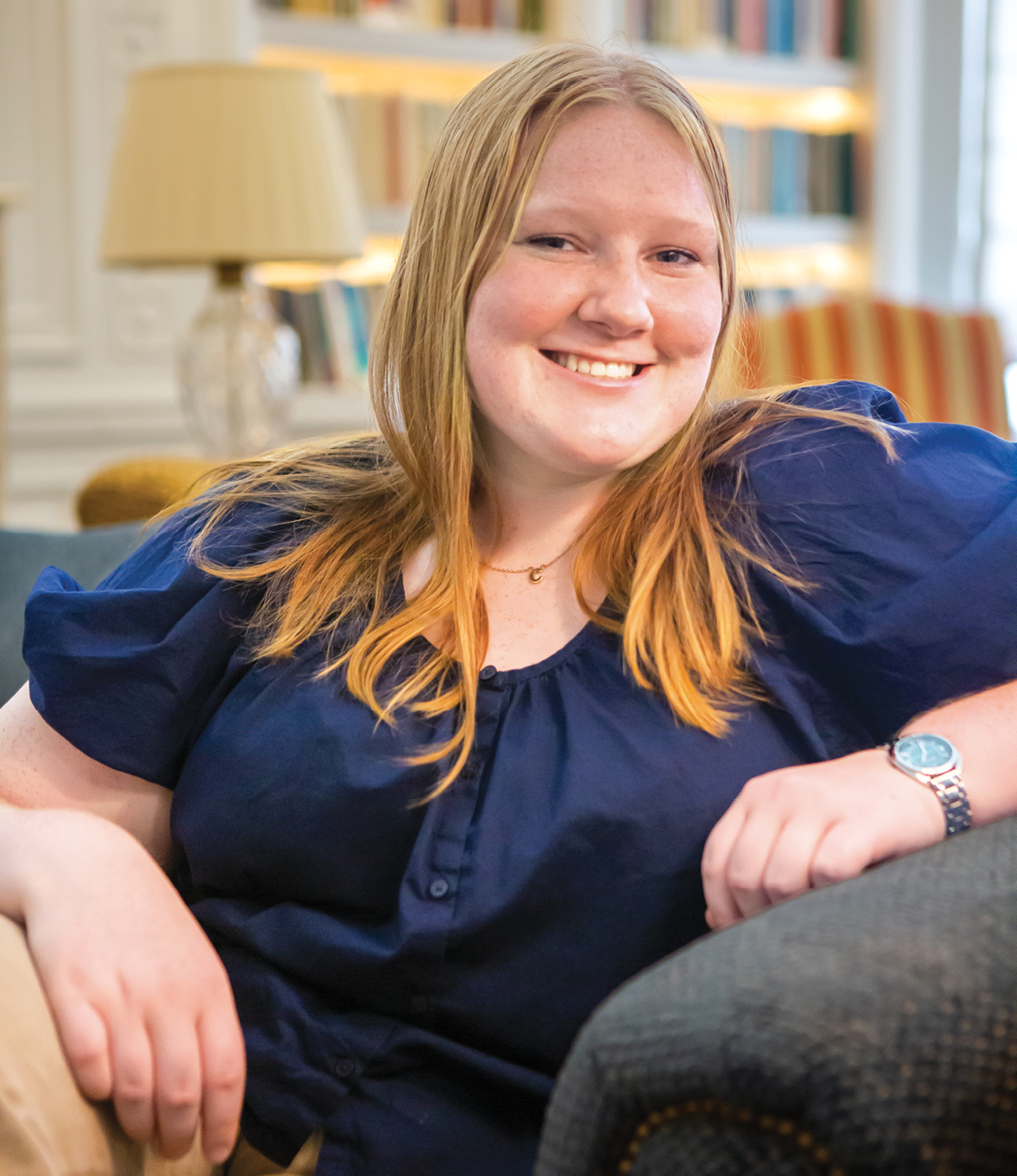
Carly Pope studied and taught economics like her grandfather. And like her father, she landed her first post-grad job at the American Enterprise Institute think tank in Washington, DC. Photo by Bradley Slade.
Along the way Jeremy spent time researching Congress at the American Enterprise Institute (AEI), a think tank where he was surrounded by intellectuals in a variety of disciplines. As a researcher Jeremy has made a name for himself by taking the pulse of American voters through large-scale surveys—from Utah exit polling at BYU’s Center for the Study of Elections and Democracy to acting as a principal investigator of the massive Cooperative Election Survey.
Recent BYU grad Carly J. Pope (BS ’26)—daughter of Jeremy and granddaughter of Clayne—adds yet another generational overlay to the Pope family Venn diagram. Like her dad, she says her interests were shaped by vigorous dinnertime debate. “We would talk about an article that came out this week or what’s happening in Congress or random things that are just going on in the world,” says Carly, who was surprised as a freshman to learn that her roommates hadn’t had similar family chats.
With a nudge from Grandpa Pope to try out economics as a freshman, Carly enrolled in the dreaded Econ 110. She loved it and later became the TA. “It was so fun to teach the basic economic principles because a lot of them are very applicable to things that people do in their lives every day.” A self-proclaimed “econ girl,” she served as president of BYU’s Women in Economics club.
After graduating in April in economics (with minors in political science and math), she followed in her father’s footsteps by landing an AEI research position studying society and culture with the Survey Center on American Life. She’s especially interested in public policy, where economic and political theory meet the road.
In their respective journeys, all three insist there has been neither coattail hanging nor string pulling, but they don’t deny the role of family or the intellectual inheritance that has shaped their understanding, interests, and how they measure success.
“We are consumers of what’s going on in the world,” says Carly. “We need to understand so that we can be active participants.”